

Photo: Intuitive Machines.
Yesterday, Intuitive Machines Nova-C class IM-2 lunar lander “Athena” touched down on the lunar surface safely, but in a position feared to be suboptimal.

Yesterday, Intuitive’s CEO Steve Altemus said in his remarks at a Post-Landing press conference, “We don’t believe we’re in the correct attitude on the surface of the moon.” In other words, not fully upright. Intuitive added that they were working to gather additional data last night and that they would provide an update when the company’s engineers reached solid conclusions.
That update came this morning with Intuitive Machines saying:
Images downlinked from Athena on the lunar surface confirmed that Athena was on her side. After landing, mission controllers were able to accelerate several program and payload milestones, including NASA’s PRIME-1 suite, before the lander’s batteries depleted.
With the direction of the sun, the orientation of the solar panels, and extreme cold temperatures in the crater, Intuitive Machines does not expect Athena to recharge. The mission has concluded and teams are continuing to assess the data collected throughout the mission.
This southern pole region is lit by harsh sun angles and limited direct communication with the Earth. This area has been avoided due to its rugged terrain and Intuitive Machines believes the insights and achievements from IM-2 will open this region for further space exploration.
Intuitive Machines IM-2 Mission Updates, Retrieved March 7, 2025
At this time, it is unclear which, if any, of the instruments other than the PRIME-1 suite the lander carried were able to provide data before the mission’s conclusion. Prime-1, or the Polar Resources Ice Mining Experiment-1 (PRIME-1) was one of the primary activities planned the the IM-2 mission.
Other Experiments Aboard IM-2
Micro-Nova Hopper “Grace”: A drone equipped with a neutron spectrometer, Grace is designed to explore permanently shadowed regions (PSRs) within the nearby Marston crater. Its mission is to provide the first surface measurements of hydrogen in these PSRs, an essential indicator of water presence on the moon.
Lunar Outpost’s MAPP Rover: This commercial rover will autonomously map the lunar surface, capture stereo images, and collect thermal data. It is equipped to inspect samples of lunar regolith, contributing to the assessment of in-situ resource utilization (ISRU) potential.
Nokia’s Lunar Cellular Network: In collaboration with Nokia, the mission will deploy the first cellular network on the Moon, utilizing LTE technology to facilitate efficient data transmission between lunar assets and Earth.
Given that they were not mentioned in the Intuitive Machines update, it is reasonable to assume that those experiments could not be deployed.
This is the second attempt Intuitive has made to land on the moon with their Nova-C lander, with both attempts resulting in successful soft touchdowns but with the lander on its side and unable to complete its experiments fully.

IM-2 Improvements Over IM-1

In his remarks at yesterday’s joint press conference with NASA, Intuitive Machines’ Chief Growth Officer Dr. Tim Crain pointed out several major improvements to the company’s Nova-C spacecraft:
“They’ve always pointed the old offensive lineman about heavy lifting That’s kind of the way it works sometimes,” Tim Crain began. Crain is a former University of Texas Longhorn football player.
“I’d like to paint a little bit of a picture going back to Valentine’s day of last year when we launched Odysseus. Every day that we went in on that mission, it seemed like that vehicle was just trying to escape our grasp and we had to put out brush fires and understand how the systems we’d built were really working in space. And so every day was a challenge on that mission.”
“And then finally,” Dr. Crain continued, “We ended up on the surface and successfully communicating and operated for many, many days. After the mission, the team got together and we made a list of all the things we had. [We asked outselves] what do we need to change for the next mission? And we had 65 items. 10 were critical, the others were, well, if we can get these in for IM- 2, we will. But if not, they can wait on IM- 3 and it’s probably enough. We got all 65 of those in on this mission. “
“We took a couple of days off after the previous mission,” he said. “Then we got together, we do what we call a hot wash. And the first hot wash I did was on Project Morpheus when I was at NASA when we lost a And then we did a hot wash of all the things we wanted to And eight months later, we’re up and flying better than ever,” Crain said.
“So that was the experience kind of leading into spring of last year, April timeframe. These are all of the improvements that we wanna make. Our orbit determination needed improvement. We had people flying around the world to improve our ground sites to give us better measurements,” Dr. Crain continued.
“We partnered with NASA to have validation and cross- check data to make sure that our systems would work the way they’re supposed to. We had issues that we learned on the way we controlled our engines that we wanted to. Our thermodynamic venting system, could we make that better? Could we make it work the way we want it to work? We ran into problems on the first mission with helium management. Helium is very important to our system for pressurizing our cryogenic methane system, also for RCS.”
“And then we had measurements we wanted to make of craters that we weren’t able to get in place on the first mission. So we had a lot of new technology that we brought forward in this mission. And I’ll be honest, I had a little bit of trepidation when we launched about what some of these new things and improvements might do in the system. It was a night and day operational difference.”
“On day one, we gathered some data about our propulsion system. And then on day two, we fired the better than we’d ever fired it before. The comm systems on our Omni antennas, which aren’t even designed to bring high gain data home, worked better than our high gain antenna had worked on the first mission.”
“We get to the moon, our orbit determination was so precise that we were within a couple ofkilometers in our 100 kilometer orbit. And we didn’t even have to do a lunar correction maneuver that we had put in place, because we had to do one in an emergency on the first mission.”

Courtesy Intuitive Machines
“So it really had moved from come in on the day of operations and save the vehicle to grab your lunch pail, go in, do spacecraft operations, as this magnificent machine called Athena moved her way to the all the way into lunar orbit. And then really the last couple of days in lunar orbit, we were expecting a fully successful landing. We did see some noise on our landing sensors towards the end, our crater recognition system. It’s machine learning on board.”
“How do you tell a computer to look for the craters but identify which craters those are on the moon. [It] worked almost an order of magnitude better than we’d anticipated. So we had every reason to believe that we were gonna come down and land with all systems the way we wanted to.”
“We’re trying to evaluate exactly what happened that very last bit. But I would tell you the improvement from the last mission to the next mission, really in less than a when you consider the fact that you have to be at the Cape early, you have to be done with testing before that.”
“And I’m incredibly proud of the team. I’m incredibly proud of how well this vehicle performed. And I will tell you, the future is bright for intuitive machines to land lots and lots of cargo on the moon.”
Conclusions
Dr. Crain and all of Intutive should be proud of his team and the job that they all did in preparing for and operating this mission. While it may seem on the surface that it was a failure, in fact, it was far from it. Many lessons were learned from IM-1, applied to IM-2 and major improvements were seen. It was also the second flight of a spacecraft fueled with cryogenic propellants, both by Intuitive and both successful. The landing, up to the very last, went well.
Now, Intuitive will assess what happened, devise and test improvements and will apply them to IM-3. The date for that mission is unknown at this time.
About NASA CLPS
Both of the Intuitive Machines missions were part of the NASA’s Commercial Lunar Payload Services (CLPS) program, which is aimed at accelerating lunar exploration by partnering with private companies to deliver science and technology payloads to the Moon. Through CLPS, NASA has awarded contracts to multiple U.S. commercial space firms to develop and operate robotic landers designed to study lunar geology, search for water ice, and test new technologies that could support future crewed missions under the Artemis program. This approach leverages the agility and cost-effectiveness of the commercial sector while advancing NASA’s long-term goals of establishing a sustainable human presence on the Moon.

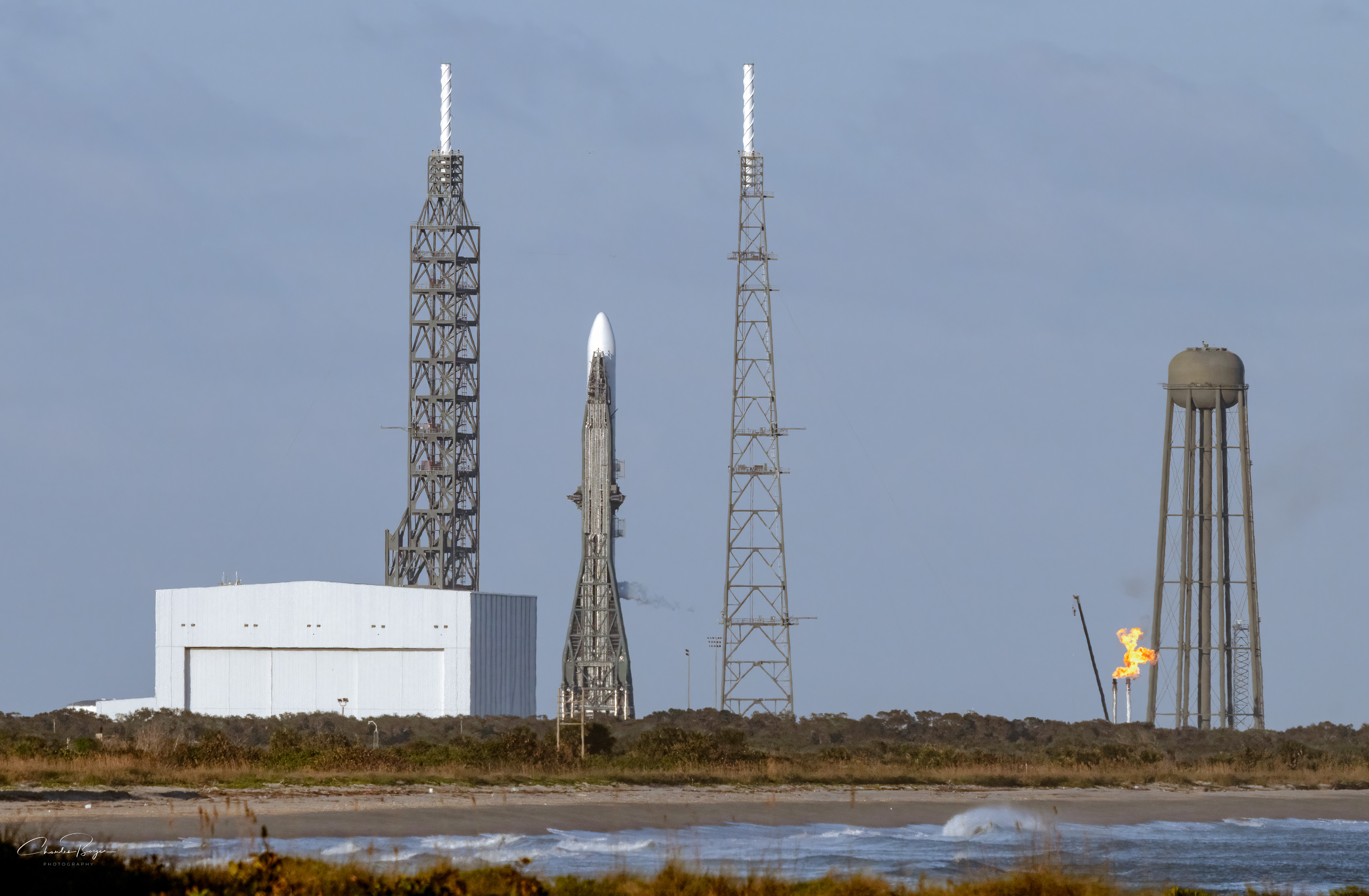
Photo: Charles Boyer / Talk of Titusville
CLPS is inherently a high-risk endeavor, as NASA is relying on unproven commercial landers to execute complex lunar landings—an area historically dominated by government space agencies with decades of experience. Many of the selected providers are developing their landers for the first time, making each mission an experimental test with no guarantee of success.
Previous attempts by private entities and even national space agencies to land on the Moon have demonstrated how technically challenging it is, with several high-profile failures in recent years and one clear commercial success: Firefly Aerospace’s Blue Ghost, which had a fully successful touchdown earlier this week.
While NASA accepts this risk as part of its strategy to foster innovation, the program’s success is far from certain, and early missions may encounter setbacks before commercial lunar deliveries become routine.


Author: Charles Boyer
NASA kid from Cocoa Beach, FL, born of Project Apollo parents and family. I’m a writer and photographer sharing the story of spaceflight from the Eastern Range here in Florida.


Leave a Reply