
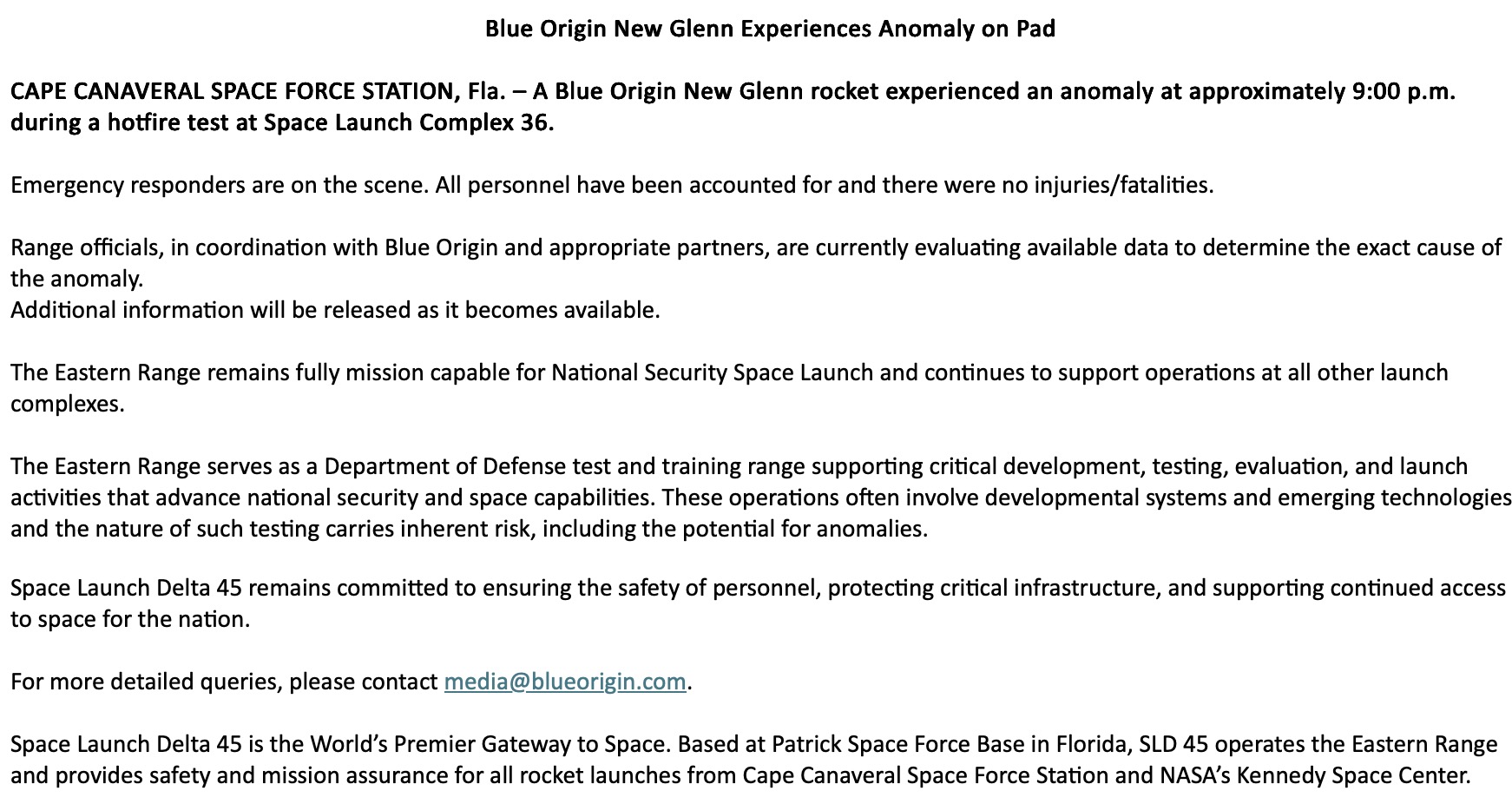
Blue Origin’s New Glenn rocket suffered an anomaly during a static fire test at Launch Complex 36 at 9:00 PM EDT Thursday, destroying the rocket, its launch equipment, and according to reports, a lightning protection tower as well. Blue Origin has reported that “all personnel have been accounted for.”
NASA Spaceflight, the popular space-focused news source, was livestreaming the planned static fire of the New Glenn rocket at 9:00 PM:
Shortly after, Spaceflight Now shared their coverage:
Blue Origin released a statement quickly, and gave some good news: no one was lost or missing.

Later in the evening, US Space Force officials released a confirmation, albeit with the clarification that not only was everyone involved accounted for, but also that there were no injuries.

“Emergency responders are on the scene. All personnel have been accounted for and there were no injuries/fatalities.”
—Space Launch Delta 45, Thursday May 28, 2026
Later, the Space Force added, “Debris from the 28 May 2026 anomaly could wash ashore along publicly accessible areas over the coming days or weeks, report debris to 911. Launch vehicle debris is potentially hazardous, direct contact poses a risk to personal health and welfare.”
USSF also gave a phone number to call if debris is found:
(321) 222-4355.
“Our first priority is always the safety of our personnel and the surrounding community. I am incredibly proud of the rapid response demonstrated by our emergency management, fire, security forces, and mission partners,” said Space Force Col. Brian Chatman, Director of the Eastern Range and SLD 45 Commander in a statement released to the press on May 29th.

Col. Chatman continued, “The professionalism displayed last night and this morning is a direct result of the countless hours our team invests in training, exercises, and preparedness alongside our government and industry partners. While we never want to respond to a real-world incident, we always prepare for the unexpected, demonstrating the expertise, discipline, and readiness that make the Eastern Range the world’s premier gateway to space.”
In the same May 29 release, “The Emergency Operations Center at Cape Canaveral Space Force Station is postured to rapidly respond to events just like this one,” said Cecil O’Bryan, who acted as director of the Emergency Operations Center after Thursday’s anomaly. “Representatives from several units ranging from fire to explosive ordnance disposal to civil engineering can respond within minutes. This helps clear the range to support 24/7 operations, even after an anomaly.”
The Eastern Range remained open, and in fact, a Falcon 9 launched about 12 hours after the New Glenn incident.
For more information from USSF: Public Advisories.
The static fire test was expected to be the final major test before NG-4, which was set to carry 48 Amazon Leo satellites to low Earth orbit. The flight would mark the first time a Blue Origin rocket launches satellites for Amazon, linking two of the better-known ventures founded by Jeff Bezos.
How Big Was The Boom?
The scale of the blast was considerable. New Glenn’s first stage burns liquid methane and liquid oxygen and carries very roughly 2.43 million pounds of propellant. On that basis, an explosion at the pad would have well over a hundred tons of TNT. For comparison, that places it well above the low-tens-of-tons estimate for the 2016 Falcon 9 pad explosion at Cape Canaveral.*

Launch Complex 36, the former Atlas-Centaur site Blue Origin rebuilt for New Glenn, has hosted three orbital launches of the 321-foot rocket since its January 2025 debut. The extent of the damage there is not known; given the massive explosion, it’s likely to be extensive and perhaps surprising.
The light at Canaveral Lighthouse is still on, and the venerable guardian of the Cape is close to LC-36: 0.72 miles (1.2 km) away.
| Event / Energy Source | Est. TNT-Equivalent Yield | Notes |
|---|---|---|
| Tomahawk cruise missile | ~0.5 tons | Warhead |
| Average lightning bolt | ~1.2 tons | Energy released |
| MOAB (Mother of All Bombs) | ~11 tons | Actual blast weapon |
| Falcon 9 AMOS-6 (2016) † | ~100 tons | Partial-fuel pad failure |
| Blue Origin New Glenn ‡ | ~125 tons | Stored energy, baseline |
| Beirut explosion (2020) | ~1.1 kilotons | Actual detonation |
| Saturn V ‡ | ~12 kilotons | Total propellant energy |
| Hiroshima “Little Boy” | ~15 kilotons | Actual detonation |
| Magnitude 6.0 earthquake | ~15 kilotons | Seismic energy |
| Hurricane (daily latent heat) ‡ | ~12.4 megatons | Not an explosion |
All figures are rough estimates intended for scale comparison only and should not be read as precise measurements.
† AMOS-6 has no officially published TNT yield. The value shown is an order-of-magnitude estimate for a partially fueled second-stage pad failure.
‡ New Glenn, Saturn V and hurricane figures are stored or released energy converted to TNT units, not actual blast yields. Rocket propellant does not detonate like a bomb, so a real-world failure would produce a substantially smaller blast.
Obviously, this is a major setback for the company and its heavy-lift vehicle just days after federal regulators cleared it to return to flight. The downstream effects are profound: New Glenn is an integral part of the Artemis program, and any major delay will affect its schedule and any commercial missions on Blue Origin’s manifest.
SpaceX Launches Starlink 10-53 Twelve Hours Later
Despite Blue Origin’s troubles 6.6 miles to the south of Space Launch Complex 40, SpaceX launched Falcon 9 on the Starlink 10-53 mission. The launch was almost exactly 12 hours after New Glenn exploded and flew successfully, with Booster B1085 touching down safely at sea aboard ASDS ‘A Shortfall of Gravitas.’

—
Talk of Titusville will continue covering this story as it develops. Veritas, non conjectura.
*NOTE: These figures are estimates derived from publicly available propellant data, not official Blue Origin numbers, and are a back-of-the-envelope estimate for illustrative purposes only.

Author: Charles Boyer
NASA kid from Cocoa Beach, FL, born of Project Apollo parents and family. I’m a writer and photographer sharing the story of spaceflight from the Eastern Range here in Florida.


Leave a Reply