


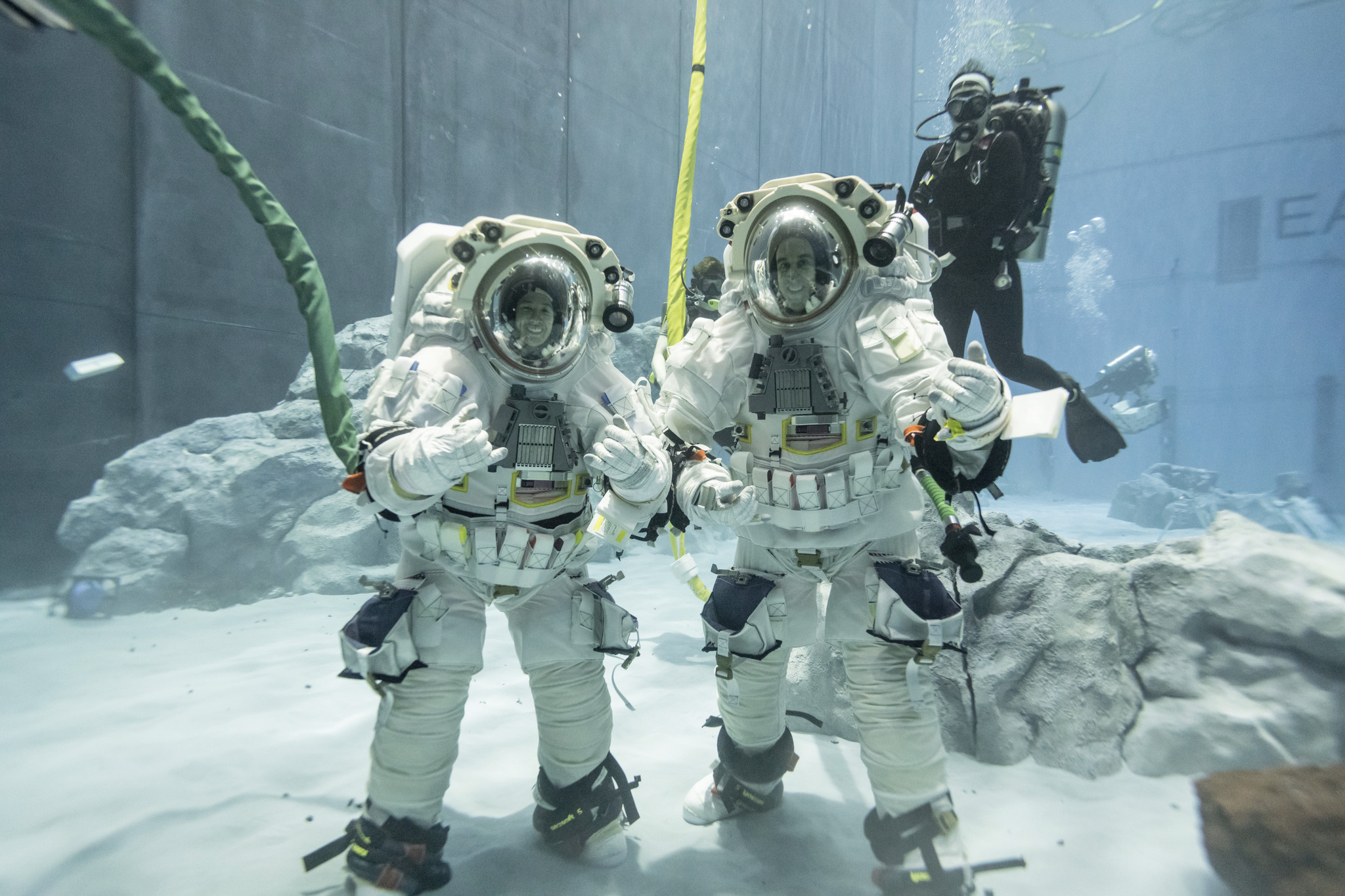
The new spacesuit is a lighter version of the AxEMU suit already far along in its development at AxiomSpace in Houston
NASA will send its first Artemis moonwalkers to the lunar surface in a lighter, simplified version of Axiom Space’s AxEMU spacesuit, cutting the suit’s original weight of roughly 500 lbs. in half. The change is to protect the agency’s 2028 landing goal, officials said Friday at Kennedy Space Center during NASA’s “Artemis Accelerate” briefing.
Artemis Program Manager Jeremy Parsons unveiled the “sortie” configuration of the Axiom Extravehicular Mobility Unit, or AxEMU, during an Artemis acceleration briefing with NASA Administrator Jared Isaacman and Associate Administrator Amit Kshatriya. The sortie suit will weigh about 250 pounds, down from a little more than 500 pounds for the baseline design.
“When you think about what has to be delivered to the lunar surface, that is a really big deal,” Parsons said.
What The Sortie Suit Is Built To Do

‘Sortie’ — from the French word ‘to exit’ — is a new spacesuit designed for short, targeted, science-driven moonwalks near the lander. It allows quicker turnaround between spacewalks and can be worn by astronauts during landing and ascent, similar to Apollo.
NASA set a minimum duration of two hours per surface spacewalk in the sortie configuration. Parsons said he expects crews to stay out longer, and that the current plan for Artemis IV calls for two moonwalks of at least two hours each.
The design reuses many certified components from the baseline AxEMU, along with lander interfaces that were already designed. It also draws on Axiom’s existing production line, infrastructure and supply chain.
The full baseline suit is not going away. NASA plans to bring it on for longer Moon Base missions that involve construction, longer surface stays and suits reused across multiple crew visits.
When it will be finished
NASA did not give a completion or certification date for the full sortie suit. Talk of Titusville has reached out to Axiom Space for a comment, but as of this time they have not yet replied. Parsons said the pressure garment will be built and delivered by the end of 2026, with work moving directly into the life support system after that.
The suit is being built by a blended Axiom and NASA team, with NASA staff working inside Axiom facilities. Parsons described the schedule as ambitious and said the team is showing “a lot of progress.”
Contract Changes
The contract is changing, too. Parsons said the sortie suit will be funded through a new task order under Axiom’s existing contract, and that NASA is moving away from the original spacesuit-as-a-service model.
“A service contract for a suit where NASA is the only user really didn’t make a lot of sense,” Parsons said. NASA is paying on a cost-reimbursable bridge contract now, plans to shift to incentive and performance-based payments, and expects to buy later suits at a firm fixed price. He declined to give a dollar figure while pricing is still being negotiated.
How The New Spacesuit Will Be Tested
NASA still plans to demonstrate the baseline AxEMU on the International Space Station in 2027. Parsons called that a significant risk-reduction step for Artemis IV, because more than 50% of the life support components are shared between the two configurations.

The full sortie suit will not fly on Artemis III, the low Earth orbit test mission targeted for summer 2027. Parsons said build time is one reason, and that a suit flown on that mission would have to stay with the lander and burn up when it reenters the atmosphere.
Instead, NASA is looking at partial tests on Artemis III, such as whether astronauts can put on and take off the suit by themselves inside the lunar crew module of Blue Origin’s test lander. Instrumentation on the crew module could also measure the loads a suit would experience during launch. Parsons said the specifics are still being worked out.
Axiom and NASA are also completing development and training at the Neutral Buoyancy Laboratory in Houston. Separately, the Artemis III crew will evaluate the Orion Crew Survival System launch and entry suits, a test that was not completed on Artemis II.
Is it on track for Artemis IV?

NASA’s official answer is yes. “We are not changing our timelines. We’re changing how we do things,” Parsons said.
The briefing also showed where the suit schedule is under pressure. Isaacman said pressurized tanks needed for the spacesuits were among components that fell well behind schedule, and that NASA is pushing for higher federal defense priority ratings to move those parts to the front of the line.
The suit must also be ready for whichever lander NASA picks. The agency has not chosen between SpaceX’s Starship and Blue Origin’s Blue Moon Mark 2 for the first landing, and both companies are targeting 2028, with SpaceX’s crewed landing aimed at the back half of that year.
With no public delivery date for the complete suit, the milestones to watch are the pressure garment delivery by year’s end, the start of life support system work, the 2027 space station demonstration and the don and doff tests on Artemis III.

Author: Charles Boyer
NASA kid from Cocoa Beach, FL, born of Project Apollo parents and family. I’m a writer and photographer sharing the story of spaceflight from the Eastern Range here in Florida.



Leave a Reply