

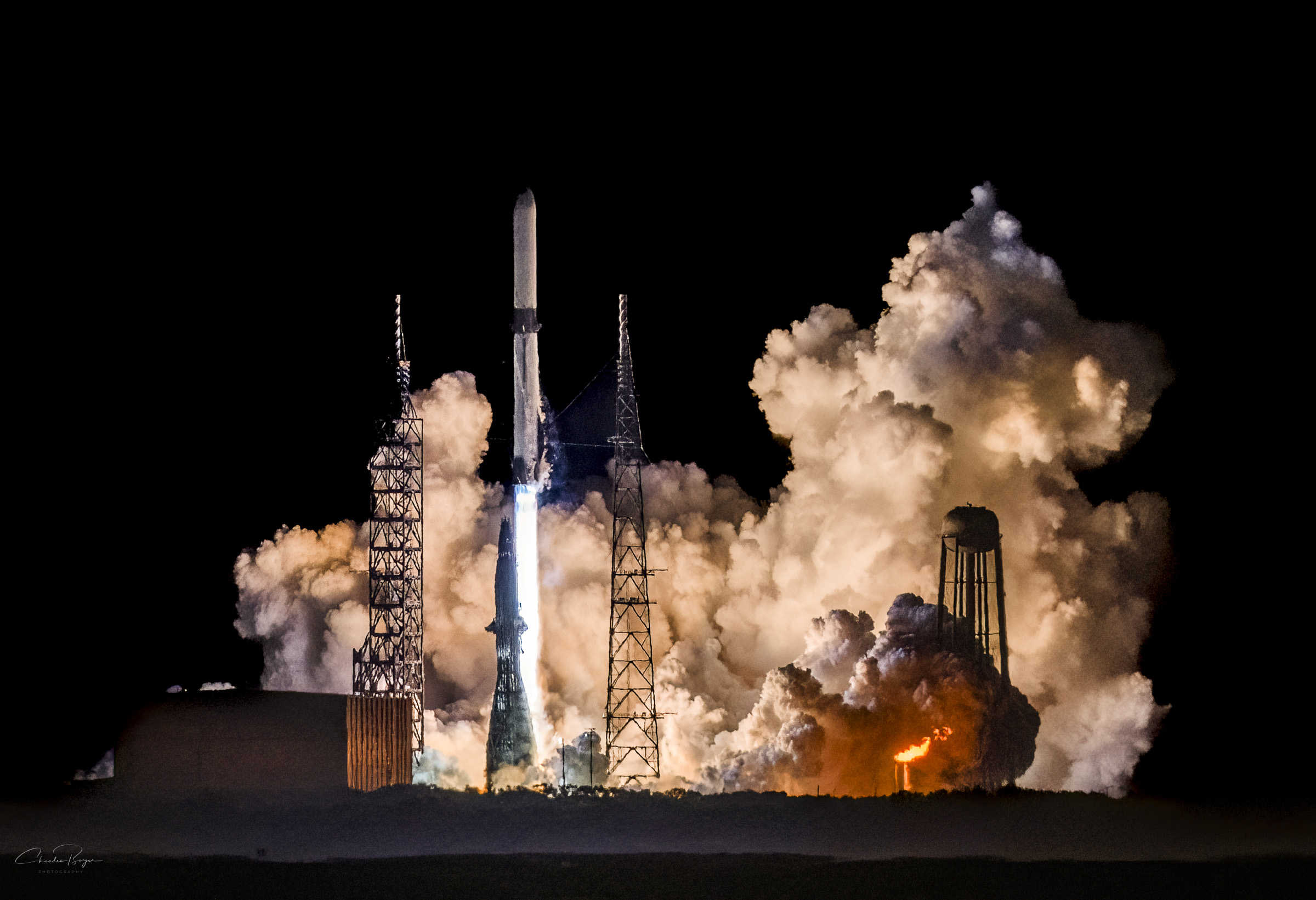
The Federal Aviation Administration has issued a Finding of No Significant Impact and Record of Decision for launch operations of Relativity Space’s Terran R at Space Launch Complex 16 (SLC-16) at Cape Canaveral Space Force Station. The document, signed September 17th by Stacey M. Zee, manager of the FAA’s Operations Support Branch, allows the agency to move forward with a vehicle operator license.
The FAA did not conduct its own environmental study. Instead, it formally adopted the 2024 Final Supplemental Environmental Assessment prepared by the U.S. Space Force, which issued its own finding of no significant impact on January 30, 2024. The FAA served as a cooperating agency on that assessment.
Launch Cadence Set
The FAA document authorizes a maximum cadence of 24 launches per year on azimuths from 41 to 105 degrees. Early missions may expend the first stage in the Atlantic, but nominal flights will land boosters on an ocean barge. The second stage will be sent to a disposal orbit and burn up on reentry, with any surviving debris falling into the open ocean. This is similar to how SpaceX Falcon 9, though Relativity has not planned to return the Terran R to its launch site.
Relativity says Terran R will fly from Launch Complex 16 starting in late 2026, powered by 13 Aeon R engines on the first stage and a single Aeon V vacuum engine on the second. Construction at the pad is ongoing and includes a new launch pad and flame trench, a horizontal integration facility, lightning towers, two flare stacks and liquefied natural gas and liquid oxygen tanks.
FAA Notes Impact On Airlines
The most notable section of the document is an airspace analysis the FAA completed after finalizing the Space Force assessment. Using 2025 flight data, the agency found each Terran R launch could affect as few as 11 commercial aircraft per hour during overnight lulls and as many as 383 per hour at peak travel times.
Launch hazard areas could close up to two dozen air routes off the coast and further downrange where boosters land. Domestic flights that normally follow over-water coastal routes would be pushed inland, adding congestion and travel time. The FAA said it may need ground stops, miles-in-trail spacing and reroutes, and noted that some international flights could simply delay departure because fuel limits prevent them from accepting a long detour.
The hazard areas do not sit over any Florida airport, but the document says they could still indirectly affect arrivals and departures. The southernmost trajectories reach Bahamian airspace, where the Bahamas would be expected to close airspace up to 6,000 feet and the FAA would handle everything above.
The agency declined to put a dollar figure on the disruption.
Noise Not An Issue
Unlike other rockets, for example, SLS or Starship, launch noise is not expected to be a problem for Terran-R. The FAA found launch noise would not reach residential areas in significant amounts. A launch could produce peak sound levels of 115 A-weighted decibels within 0.83 miles of the pad, all inside the CCSFS permimeters. The day-night average noise contours of 65 and 60 decibels stretch about 2.8 and 3.2 miles respectively, remaining within CCSFS and Kennedy Space Center.
Public input was limited. The draft assessment was open for comment from Aug. 8 to Sept. 9, 2023, with copies at six Brevard County libraries, including Titusville Public Library. The Space Force received three public comments.
The FONSI Has Limited Coverage
The ruling covers only the FAA’s licensing and airspace decisions. Construction oversight and related mitigation remain the Space Force’s responsibility.
Any future license request that falls outside the scope analyzed in the assessment would require additional environmental review.
Note: Talk of Titusville asked Relativity to comment on the FAA’s findings, but they have not responded as of this time. We will include any comments from Relativity when and if they answer our query.


Leave a Reply