

The deepest lunar eclipse in nearly two years arrives Thursday night, and the Space Coast has one of the best seats on Earth for the event. Our home planet’s shadow will cover about 96 percent of the moon’s visible face at maximum, leaving a thin white sliver along the northern edge and a copper red glow across the rest. Weather permitting, the entire event is visible here from start to finish, with the moon riding high in the southern sky. No filters, glasses or telescopes are required.


The moon enters the faint outer penumbral shadow at 9:23 p.m. Thursday, though the dimming at that stage is subtle enough that most people will not notice it. The obvious part begins at 10:33 p.m., when the dark umbral shadow takes its first bite out of the disk. Maximum eclipse comes at 12:12 a.m. Friday. The full Sturgeon Moon arrives six minutes later at 12:18 a.m.
| Phase | Time (EDT) | What to Watch For |
|---|---|---|
| Penumbra begins | 9:23 p.m. Thu. | Almost imperceptible shading on the lower left limb |
| Partial begins | 10:33 p.m. Thu. | A hard curved shadow edge starts crossing the disk |
| Maximum eclipse | 12:12 a.m. Fri. | 96 percent covered, deep orange red with one bright sliver |
| Partial ends | 1:51 a.m. Fri. | Umbra clears the disk and full brightness returns |
| Penumbra ends | 3:01 a.m. Fri. | Event over, total run time 5 hours 38 minutes |
This is technically a partial eclipse, but it will not look like one. The umbral magnitude is 0.93, meaning 93 percent of the moon’s diameter and roughly 96 percent of its visible surface fall inside the umbra. That leaves a brilliant white crescent along the northern limb while the rest of the moon glows the color of every sunrise and sunset on Earth combined. Observers with binoculars should also look for a pale turquoise band between the sliver and the red, an effect of ozone in Earth’s upper atmosphere absorbing red light.
It is the first deep partial lunar eclipse anywhere on Earth since September 2024 and the last until January 2028. Astronomers rank it as the most impressive lunar eclipse of any kind until the total eclipse of Dec. 31, 2028.
Where to Watch Locally
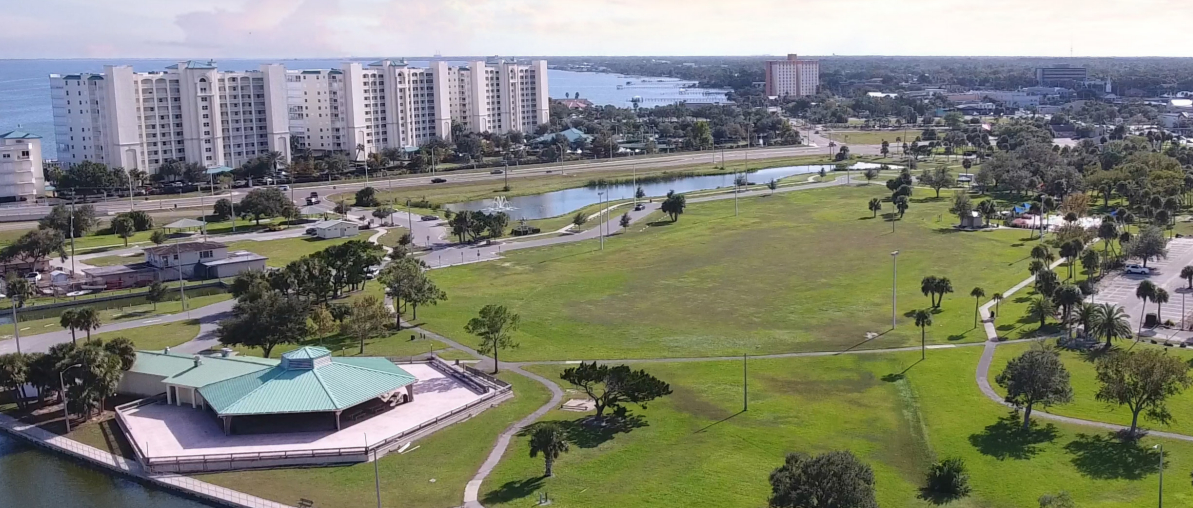
The moon will sit roughly 50 degrees above the southern horizon at maximum, so an open water view is not necessary. Any spot out of direct streetlight glare will do, including a driveway or a backyard. Parrish Park and Space View Park both offer wide sky and easy parking for anyone who wants to get away from porch lights. Playalinda Beach closes at sunset and is not an option for this one.

Late August weather is the wild card. The typical Space Coast pattern puts afternoon storms over the interior that collapse after dark, but leftover high cloud can linger. This may dim the eclipse slightly, but unless cumulus clouds crowd the skies, the full moon should be clearly visible.
“Thursday August 27 Titusville Forecast
Showers and thunderstorms likely, mainly before 8pm. Partly cloudy, with a low around 77. South-southeast wind around 5 mph. Chance of precipitation is 60%.” – National Weather Service
At the time of this writing—Monday, August 24—the weather outlook is somewhat questionable, but this is Florida. That means despite any prediction, the weather can and will spin on a dime here, so one never knows exactly what will happen until it actually starts happening. That said, Space Coast residents should get a great view of the celestial event.

Author: Charles Boyer
NASA kid from Cocoa Beach, FL, born of Project Apollo parents and family. I’m a writer and photographer sharing the story of spaceflight from the Eastern Range here in Florida.




Leave a Reply