

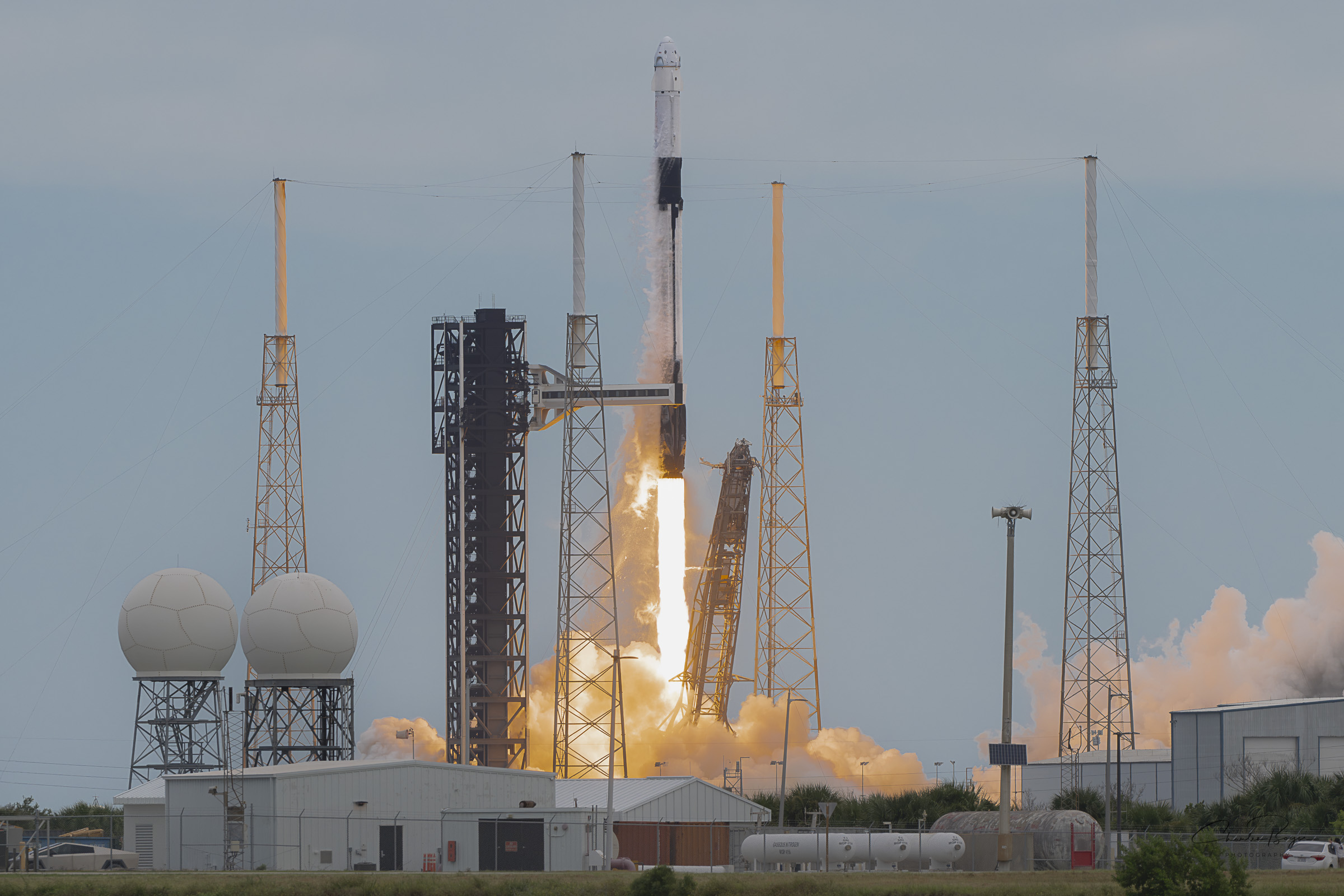
Forty-nine years ago today at 10:29 AM ET, two solid rocket motors lit at Launch Complex 41 and moved a 157-foot Titan IIIE-Centaur off the pad with 2.4 million pounds of thrust. Its payload, Voyager 2, is still working, still returning data and still the only human-built object to have flown past Uranus and Neptune. It is also one of two man-made objects to ever enter interstellar space, and that long journey began here, at Cape Canaveral.


Photo: NASA
The rocket that started it was already a museum piece in the making. The Titan IIIE-Centaur flew only seven times between February 1974 and September 1977. It failed on its first attempt, then delivered the twin Helios solar probes, both Viking orbiter-lander pairs and both Voyagers without another loss. Voyager 2 rode Titan/Centaur-7, the second-to-last of the breed. Voyager 1 took the last one, TC-6, on Sept. 5.
Today, Voyager 2 is now about 13.2 billion miles from the beachfront it left behind. That is roughly 143 astronomical units, far enough that a command sent from the Deep Space Network takes close to 20 hours to arrive.
Why Did Voyager 2 Launch Before Voyager 1
Celestial mechanics dictated the launch order of the two probes: Voyager 2 had to leave about a month before its fraternal twin, Voyager 1.
Voyager 1 had the shorter, faster trajectory to Jupiter and Saturn. Voyager 2 drew a longer, more patient path that preserved the option of continuing to Uranus and Neptune if the first spacecraft succeeded and the second stayed healthy. That option depended on a planetary alignment that comes around roughly every 175 years, and capturing it required leaving Earth before the end of August 1977. So the slower spacecraft went first, and the faster one caught and passed it in December of that year.

Close Call

The mission that would become NASA’s most quietly durable success very nearly came apart in its first hours.
Voyager 2 suffered a double computer failure while the rocket sat on LC-41 before launch. Engineers cleared it, the countdown resumed, and the Titan flew a clean profile. The core stage picked up at 112 seconds; the second stage carried the vehicle for another three and a half minutes, and the Centaur second stage burned twice: first into a parking orbit and then for more than five and a half minutes to reach escape velocity.

Credits: NASA/JPL-Caltech
Then the spacecraft itself started arguing with reality. It separated from the booster faster than its software expected, concluded that its primary attitude control system had failed and swapped to the backup. Fault protection routines designed to save the spacecraft years later in deep space tripped instead within hours of liftoff. For roughly 90 minutes it wrestled itself back into a stable attitude. Telemetry also suggested the science scan platform had not deployed. That one turned out to be a bad sensor.
Seventy-one minutes after leaving the Cape, a kick stage ignited for 45 seconds and committed Voyager 2 to fly towards Jupiter.
Talk of Titusville will always be free to access.
If you love what we’re doing, please consider becoming a monthly Supporter HERE.

Credits: NASA/JPL-Caltech
The worst was still ahead. In April 1978 the spacecraft lost its primary radio receiver, and a failed tracking loop capacitor in the backup meant that receiver would only answer commands sent at exactly the right frequency. Engineers had to compute that frequency while accounting for the rotation of Earth, the motion of the transmitting antenna, the motion of the spacecraft and thermal drift aboard Voyager itself, where a one-degree change could shift the tuning by dozens of hertz. Voyager 2 has been listening through that damaged backup ear for 48 years.
| Launch | Aug. 20, 1977, 10:29 a.m. EDT |
| Pad | Launch Complex 41, Cape Canaveral Air Force Station, now SLC-41 at Cape Canaveral Space Force Station |
| Launch vehicle | Titan IIIE-Centaur (TC-7), 157 feet tall, plus a Star 37E kick motor |
| Spacecraft mass | About 1,800 pounds, 10 science instruments at launch |
| Jupiter flyby | July 9, 1979, about 350,000 miles above the cloud tops |
| Saturn flyby | Aug. 25, 1981 |
| Uranus flyby | Jan. 24, 1986, first and only, 10 new moons and two new rings found |
| Neptune flyby | Aug. 25, 1989, first and only, five moons, four rings and the Great Dark Spot found |
| Interstellar space | Crossed the heliopause Nov. 5, 2018 |
| Distance from Earth | About 13.2 billion miles, roughly 143 astronomical units |
| One-way signal time | Close to 20 hours |
| Power | Three radioisotope thermoelectric generators, about 470 watts at launch, losing roughly four watts a year |
| Instruments operating | Three, extended at least one more year by the Aug. 4, 2026 power swap |
Distance and signal time are approximate and increase daily. Source: NASA Jet Propulsion Laboratory.
Primary Mission
Jupiter came on July 9, 1979, with closest approach about 350,000 miles above the cloud tops and roughly 17,000 images returned. Saturn followed in August 1981. Then came the part nobody had promised the taxpayers: Uranus on Jan. 24, 1986, where the spacecraft found 10 new moons and two new rings, and Neptune on Aug. 25, 1989, where it found five moons, four rings and the Great Dark Spot.
That Neptune encounter turns 37 next Tuesday.
So far, Voyager 2 is humanity’s only foray to Uranus and Neptune, and it provided only fleeting glimpses with relatively primitive instruments.
After Neptune, Voyager 2 kept traveling and was healthy.
On Nov. 5, 2018, Voyager 2 crossed the heliopause and became the second object ever to enter interstellar space. It still carries the Golden Record bolted to its side, the copper phonograph disc of greetings, music, and images assembled under Carl Sagan, just in case an extraterrestrial intelligence were to ever encounter the spacecraft.
Today, Voyager 2 Continues Its Journey
The Voyagers run on radioisotope thermoelectric generators that started out producing about 470 watts each and have been shedding roughly four watts a year ever since. Nearly half a century in, every remaining watt is spoken for by heaters, the transmitter and whatever instruments are still switched on.
That math has forced a slow triage. Voyager 2 lost its plasma science instrument in September 2024 and its low-energy charged particle experiment in March 2025. Voyager 1 gave up its cosmic ray subsystem in February 2025 and its own low-energy charged particle instrument in April of this year. Three instruments were still running on Voyager 2, and one of those was scheduled to be turned off before the end of the year this year. The old bird may still be flying, but she is showing her age now.
Recently. in an operation the team nicknamed the Big Bang, engineers commanded the spacecraft to simultaneously shut down a set of powered devices and bring up lower-power substitutes, a swap that had to preserve enough waste heat to keep a 49-year-old machine from freezing solid. It worked. All three instruments stay on for at least another year. Voyager 1 is expected to attempt the same trick in the coming months, and if it works there, the team has floated the possibility of restarting the instrument it shut down in April.
Suzanne Dodd, the project manager at JPL, has called the Voyagers deep space rock stars. Project scientist Linda Spilker has put it more bluntly, noting that every day could be the last one and also could bring another discovery.
Both statements have been true every day since 10:29 AM on that hot Saturday morning in 1977. Voyager 2 is not done and has an extremely long journey ahead of her.

Author: Charles Boyer
NASA kid from Cocoa Beach, FL, born of Project Apollo parents and family. I’m a writer and photographer sharing the story of spaceflight from the Eastern Range here in Florida.


Leave a Reply