

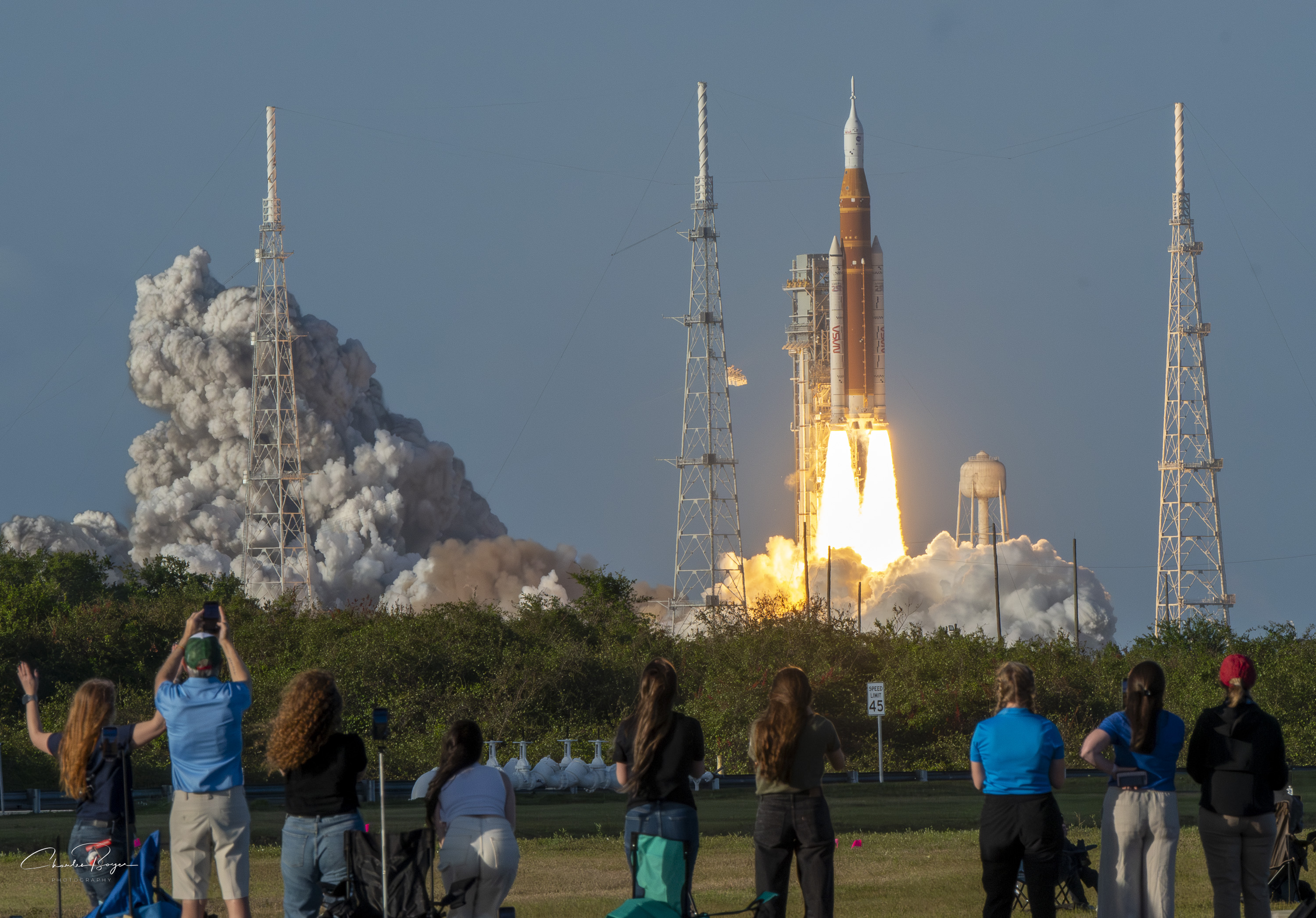
Summer thunderstorms have yet to arrive on the Space Coast this year, but there were rumbles and roars a-plenty yesterday on the Eastern Range. First, in the wee hours, SpaceX launched CRS-32 from KSC, and its booster landed at Landing Zone 1 at Cape Canaveral Space Force Station. Then, after sunset, the company completed another RTLS Falcon 9 launch, this time from Space Launch Complex 40 at Cape Canaveral Space Force Station. Liftoff was at 8:48 PM ET.

Eight minutes and seven seconds after liftoff, Booster B1090 completed its third flight successfully at Landing Zone 2 on the site of the former Launch Complex 13.
Payloads
Among the payloads that were launched last night were some interesting spacecraft:
425Sat-3: Enhancing South Korea’s Reconnaissance Capabilities
425Sat-3, as part of the 425 Project, was among the payloads lofted by Bandwagon-3. This initiative aims to establish a constellation of five satellites—four equipped with Synthetic Aperture Radar (SAR) and one with Electro-Optical/Infrared (EO/IR) sensors—to bolster surveillance over North Korea. T

The SAR satellites, developed by a consortium including Korean Aerospace Industries, Hanwha Systems, and Thales Alenia Space, provide all-weather, day-and-night imaging capabilities. Once fully operational, the constellation will enable monitoring of the Korean Peninsula at two-hour intervals, enhancing South Korea’s independent intelligence-gathering capacity, a vital national interest item.
Tomorrow-S7: Advancing Hyperlocal Weather Forecasting
Tomorrow-S7, launched by Tomorrow.io, represents a significant step in commercial weather observation. As part of a planned 30-satellite constellation, Tomorrow-S7 is equipped with advanced radar and microwave sounder instruments designed to deliver precise, hyperlocal weather data. This satellite aims to improve forecasting accuracy for both commercial and governmental applications, particularly in regions lacking comprehensive weather monitoring infrastructure.
PHOENIX-1: Testing Innovative Reentry Technology
PHOENIX-1, developed by Germany’s Atmos Space Cargo, is a prototype reentry capsule launched to test new technologies for returning cargo from Low Earth Orbit. The capsule features an inflatable heat shield, which deploys during reentry to slow the spacecraft without the need for parachutes.
During its mission, PHOENIX-1 carried four payloads, including biological and technological experiments. The data collected will inform the development of future reusable cargo return systems, with the goal of providing efficient and cost-effective solutions for transporting materials from space.
Launch Replay
Next Launch
Lather, rinse, repeat. It may as well be SpaceX’s corporate motto, because they launch so regularly, especially in regards to their Starlink constellation. The company plans to launch another set of satellites for Group 6 NET Thursday, April 24, 2025:
| Mission | Falcon 9 Block 5 | Starlink Group 6-74 |
|---|---|
| Organization | SpaceX |
| Location | Cape Canaveral SFS, FL, USA |
| Rocket | Falcon 9 Block 5 |
| Pad | Space Launch Complex 40 |
| Status | To Be Confirmed |
| Status Info | Awaiting official confirmation – current date is known with some certainty. |
| Window Opens | Thursday, 04/24/2025 9:32:00 PM EDT |
| Window Closes | Friday, 04/25/2025 2:39:00 AM EDT |
| Destination | Low Earth Orbit |
| Mission Description | A batch of satellites for the Starlink mega-constellation – SpaceX’s project for a space-based Internet communication system. |

Author: Charles Boyer
NASA kid from Cocoa Beach, FL, born of Project Apollo parents and family. I’m a writer and photographer sharing the story of spaceflight from the Eastern Range here in Florida.


Leave a Reply