

Photo: NASA / JPL
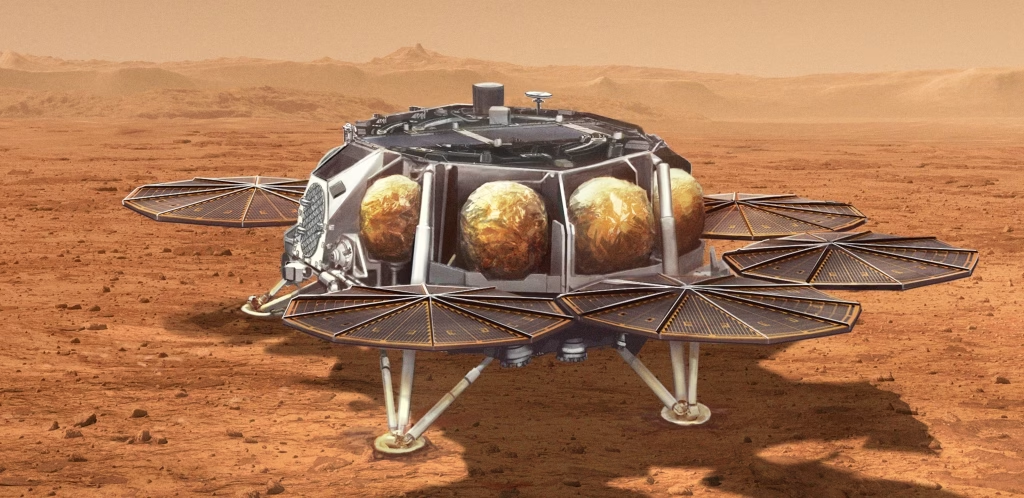
NASA’s ambitious Mars Sample Return program, which plans to land on the Martian surface, collect rock and dust samples, and return them to Earth has been delayed and will be revised due to its high costs and long lead times.

Mars Sample Return is the highest priority solar system exploration goals identified by the National Academies of Sciences, Engineering and Medicine in the past three decadal surveys, but technical capability, costs and funding have stopped the mission short of execution.
Graphic: NASA / JPL
Changes Made, In Short
“An $11 billion budget is too expensive, and a 2040 return date is too far away,” NASA Administrator Bill Nelson said today.
NASA has asked the Jet Propulsion Laboratory to create an updated mission design that “has reduced complexity, improve resiliency and risk posture, and well as well as strong accountability and coordination,” sad Nicola “Nicky” Fox, associate administrator for NASA’s Science Mission Directorate today in a NASA press conference.

Graphic: NASA
“NASA SMD will release a competitive solicitation in the immediate future for funded industry studies to investigate either 1) innovative and alternate MSR architectures or 2) innovative and alternate architecture elements, such as a smaller Mars Ascent Vehicle, that could offer lower life cycle cost, lower annual cost, provide earlier sample return,” Fox relayed in an accompanying press release.
Nelson said that JPL and other NASA centers will have until fall to prepare the new mission profile, and that sometime after that a revised plan will be released for Congressional and public scrutiny.

MSR has been in a state of limbo since last fall, when an independent review board said that the project “[an] unrealistic budget and schedule expectations from the beginning.” (Note: link goes to a PDF file.)
The board also pointed out other classical challenges for a Mars mission, such as launch window constraints (every other year), the potential for dust storms upon arrival, landing site certifications and so on.
Afterwards, Congressional appropriations committees recommended a budget that included a cut of $454.1 Million to NASA’s 2024 budget, specifically from the Mars Sample Return mission. That action left a lot of doubt about the program and whether it would be canceled outright, but it appears that NASA and JPL are attempting to put it back on track with the solicitation of new mission profiles and ideas.

Back To The Drawing Board
In response to the Independent Review Board, NASA filed a response and publicly released it today.

NASA’s response to the second Mars Sample Return Independent Review Board (MSR IRB-2)
In it, NASA says that their new plan is to make several changes to the program in order to balance current technology and innovation. They also plan to reduce programmatic and technical risk, and decouple launch readiness dates.
“Independent review boards like the one we commissioned for Mars Sample Return help review whether we’re on the right track to meet our mission goals within the appropriate budget,” Sandra Connelly, deputy associate administrator for NASA’s Science Mission Directorate, said in a statement the agency released today. “We thank the board for its work, and now our job is to assess the report and address if there are elements of the program that need to change.”

Author: Charles Boyer
NASA kid from Cocoa Beach, FL, born of Project Apollo parents and family. I’m a writer and photographer sharing the story of spaceflight from the Eastern Range here in Florida.





Leave a Reply