

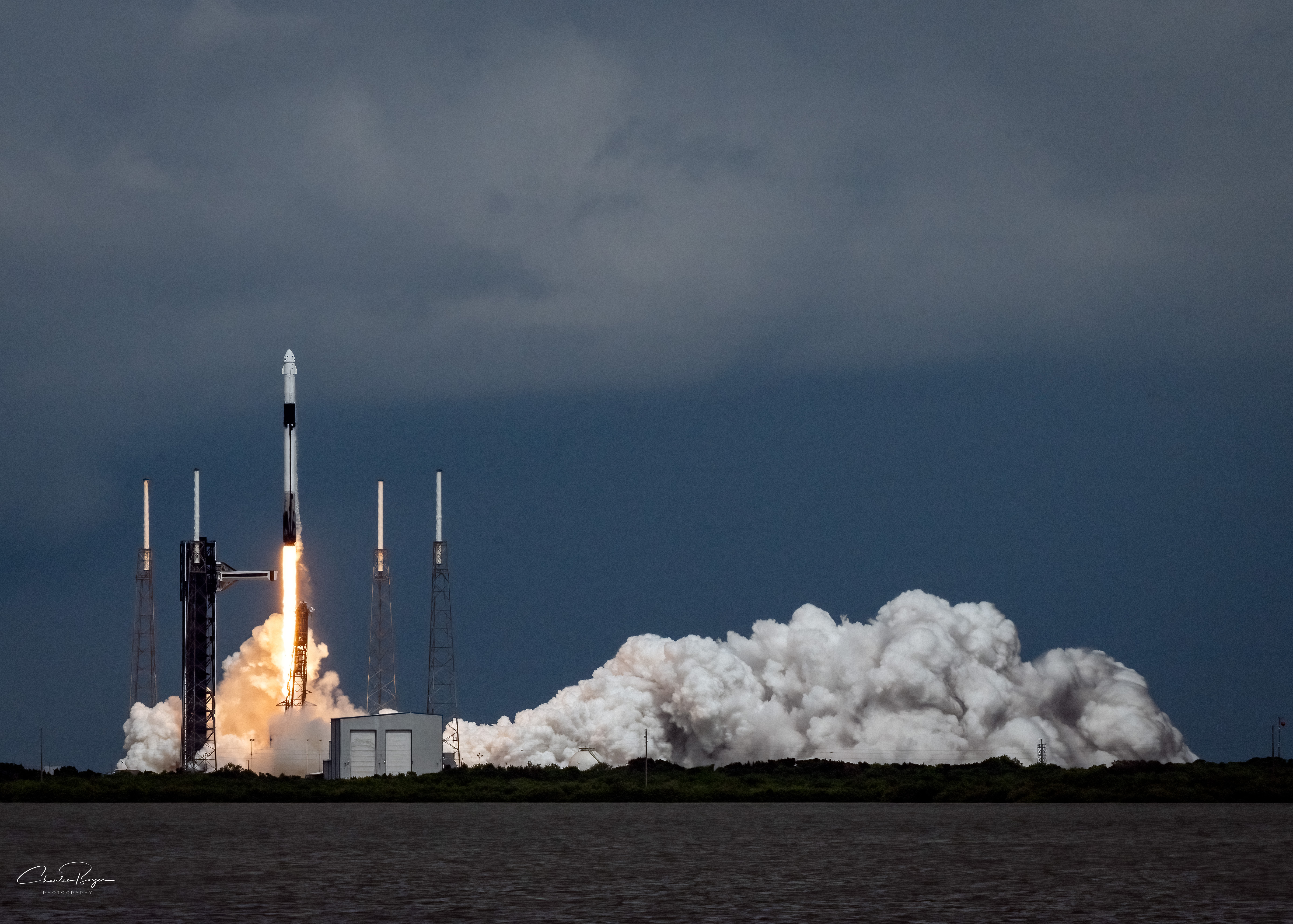
Photo: Charles Boyer / Talk of Titusville
After two delays due to high winds, SpaceX launched the PACE Earth-observing satellite to orbit from Cape Canaveral this morning. Seven and one half minutes later, Booster 1081 announced its return to the Space Coast with a sonic boom moments after safely touching down, completing its fourth flight.

The launch was the eighth for the Eastern Range this year, the 223rd orbital attempt from SLC-40, and the 923rd from Cape Canaveral.
According the Tim Dunn of NASA’s Launch Services Program, and the launch director for tonight’s flight, “PACE is the eighth NASA LSP mission to launch on a SpaceX rocket, and the first government mission to fly a polar trajectory from the Cape since November of 1960.”
SpaceX has flown polar missions commercially 11 times, Dunn added. Today’s launch was the twelfth such mission.

Photo: Ed Cordero, Florida Media Now
In a press release from NASA issued early this morning, NASA Administrator Bill Nelson said, “Congratulations to the PACE team on a successful launch. With this new addition to NASA’s fleet of Earth-observing satellites, PACE will help us learn, like never before, how particles in our atmosphere and our oceans can identify key factors impacting global warming.”


Photo: Richard Gallagher, Florida Media Now
Next Up For PACE
Following the successful launch, according to NASA , next up for PACE is a PLAR, or Post-Launch Assessment review. “The PLAR is conducted following the launch, typically after the early flight operations and initial checkout.”
“At the PLAR, the PACE project demonstrates to the review panel, the readiness of the spacecraft systems to proceed with full, routine operations; status, performance, and capabilities of the project as evidenced from the flight operations experience since launch; readiness to transfer responsibility from the development organization to the operations organization; project plans and the capability to conduct the mission with emphasis on near-term operations and mission-critical events.”
Assuming a healthy spacecraft, after the PLAR, PACE is expected to begin operations later this coming spring.
PACE Mission
According to NASA, “PACE’s data will help us better understand how the ocean and atmosphere exchange carbon dioxide. In addition, it will reveal how aerosols might fuel phytoplankton growth in the surface ocean. Novel uses of PACE data will benefit our economy and society. For example, it will help identify the extent and duration of harmful algal blooms. PACE will extend and expand NASA’s long-term observations of our living planet. By doing so, it will take Earth’s pulse in new ways for decades to come.”

Prior to the launch, Dr. Karen St. Germain, the director of NASA’s Earth Science Division said, “The surface of the Earth is covered 70% by oceans and yet in many ways we know more about the surface of the Moon than we do about our own oceans. PACE will be the most advanced mission we’ve ever launched to study ocean biology.”
She added that PACE “will join SWOT [that] we launched a little over a year ago that’s giving us the most detailed view we’ve ever had of the physical oceanography, [of] how water is moving in our oceans and that is very closely related to what PACE will tell about what’s living in our oceans.”
Booster
SpaceX used Booster 1081 for this mission, its fourth mission.
| Flight | Date | Mission | Launch Pad | Result |
| 1 | 26 August 2023 | Crew-7 | LC-39A | Success |
| 2 | 10 November 2023 | CRS-29 | LC-39A | Success |
| 3 | 19 December 2023 | Starlink 6-34 | SLC-40 | Success |
| 4 | 08 February 2024 | NASA PACE | SLC-40 | Success |
After post-landing checkouts, the booster will be returned to Hangar X at Kennedy Space Center for inspection and ostensibly for needed refurbishment and preparations needed to ready it for its next launch.
Next Launch
On February 14th NASA CLPS / Intuitive Machines IM-1 is scheduled to launch from LC-39A at Kennedy Space Center aboard a Falcon 9 booster. The listed launch time is 12:57 AM EST.

Author: Charles Boyer
NASA kid from Cocoa Beach, FL, born of Project Apollo parents and family. I’m a writer and photographer sharing the story of spaceflight from the Eastern Range here in Florida.


Leave a Reply