

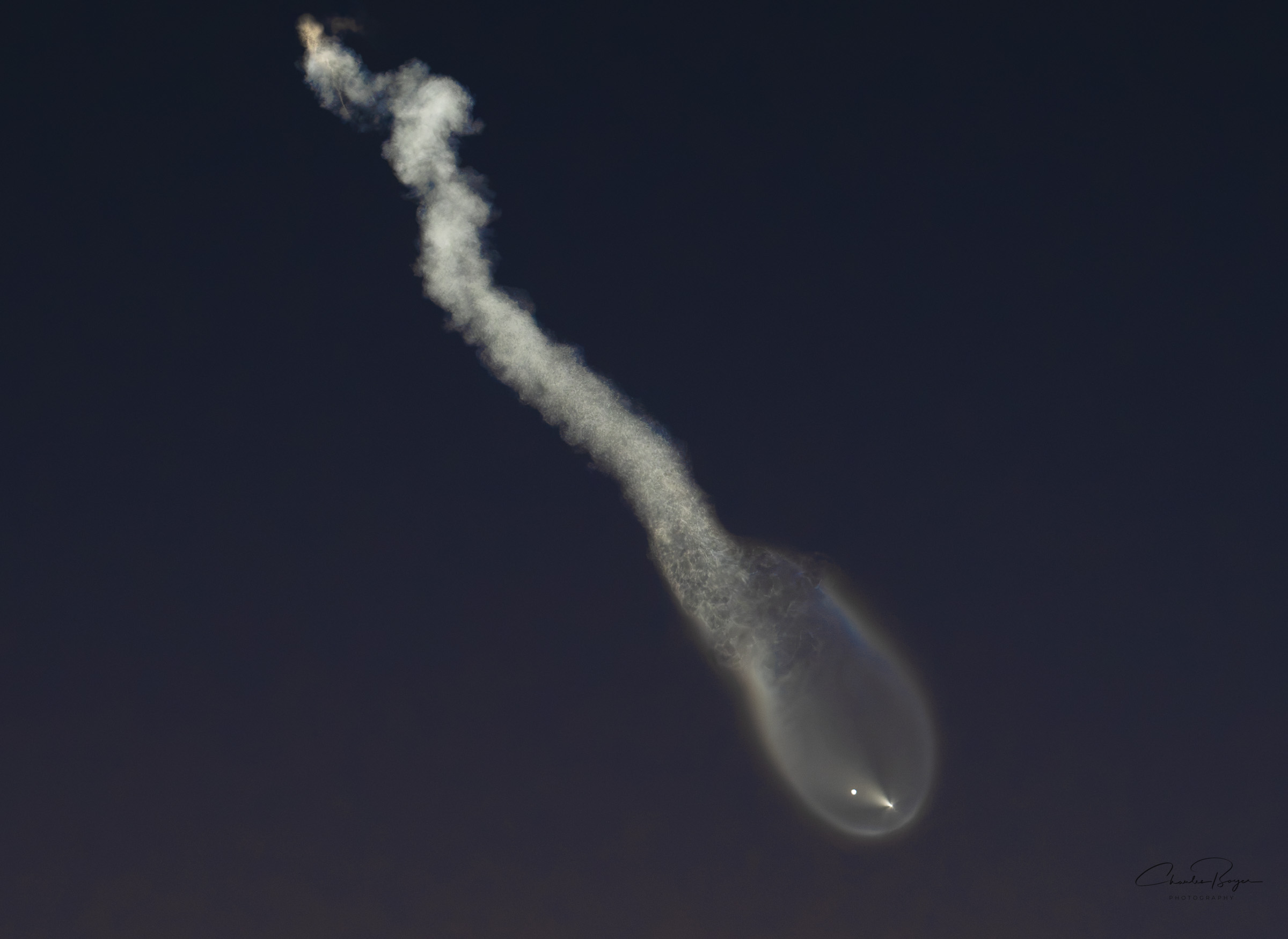
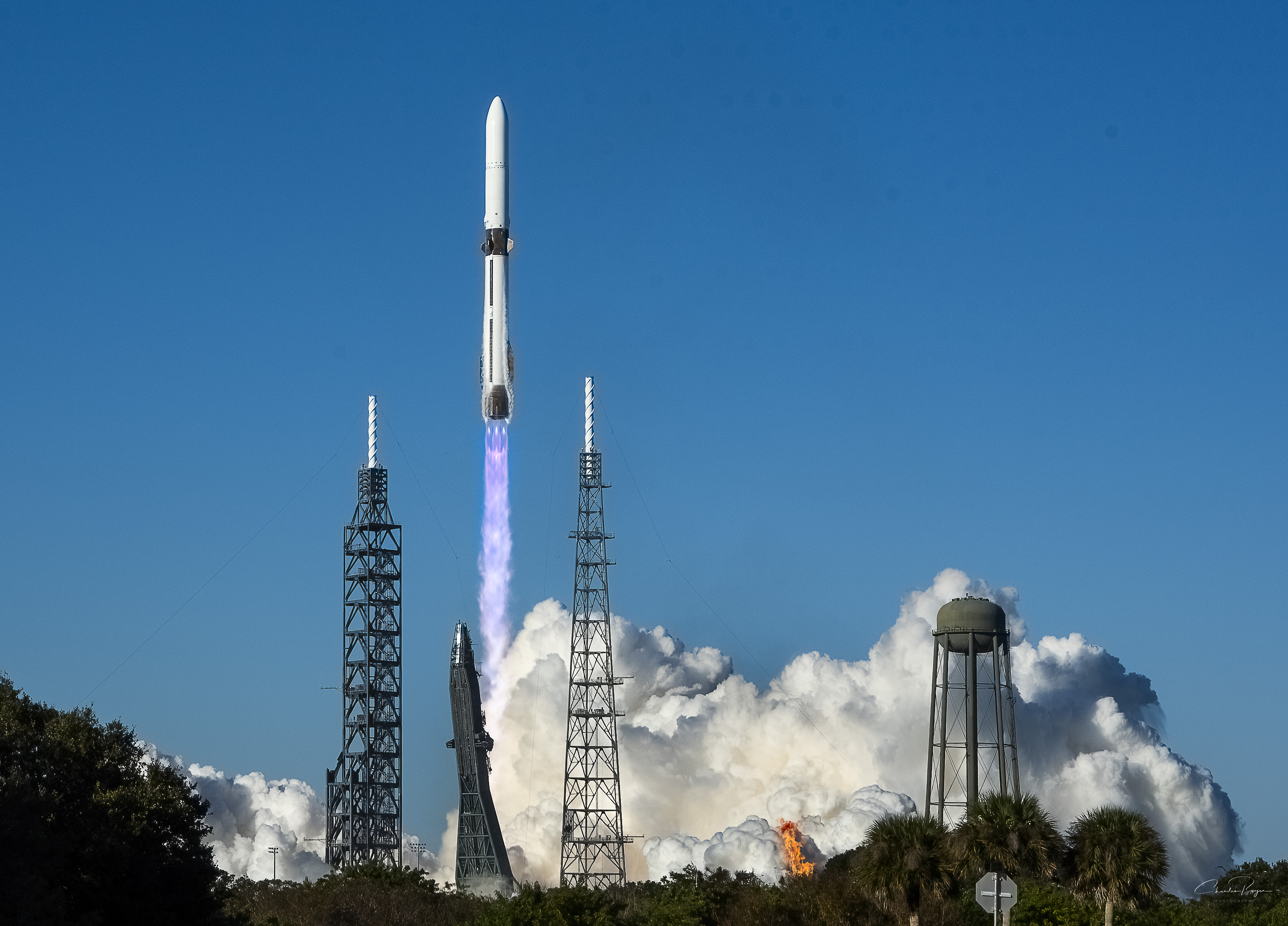
SpaceX launched a Falcon 9 and the Bandwagon 5 mission this morning from Cape Canaveral in a beautiful pre-dawn launch. Liftoff was at 7:04 AM ET into almost perfectly clear skies. The launch was successful and the booster used for today’s flight touched down safely aboard SpaceX’s droneship ASDS ‘A Shortfall of Gravitas’ at T+ 8m 58s.
Bandwagon-5 flew this morning on Falcon 9 booster B1085, making its 19th mission. B1085’s résumé includes NASA’s Crew-9, the private Fram2 polar mission, Crew 9 and Firefly’s Blue Ghost Mission 1 lunar lander, along with the RRT-1 rapid-response tanker demonstration, satellite launches for SiriusXM (SXM-10), EUMETSAT (MTG-S1) and EchoStar (EchoStar XXV), and ten Starlink missions.
Payloads

Bandwagon-5 carried 32 payloads. The headliner was SpaceX’s own hardware: the second of its Starfall capsules, mounted atop the satellite stack. The disk-shaped reentry vehicle stands about 0.75 meters (2.5 feet) tall and 3.1 meters (10.2 feet) across, weighs about 2,100 kilograms, and can carry up to 1,000 kilograms of payload, according to an FAA environmental assessment. SpaceX plans to use the vehicle for point-to-point cargo delivery and for returning goods manufactured in microgravity. Starfall first flew on a June 23 demonstration flight, and SpaceX didn’t say what, if any, payloads were aboard this one.

Starfall has company in the reentry business. Varda Space Industries flew its W-Series 7 capsule, which is roughly a third the size of Starfall. Despite the name, W-7 is Varda’s ninth reentry capsule; W-8 and W-9 launched earlier this month on Transporter-18. W-7 carries a new cancer medicine called PROTAC, and Varda is testing whether microgravity can overcome the drug’s poor solubility.
Also aboard was Portal Space Systems’ Starburst-1, a 260-kilogram spacecraft designed to perform orbital maneuvers and carry a customer payload of up to 50 kilograms. Portal paid for the demonstration itself and plans to begin customer flights in 2027.


Photo: Charles Boyer
Exolaunch, which has flown customers on every SpaceX rideshare mission, manifested roughly 20 of the satellites. These included HawkEye 360 radio-frequency monitoring satellites and Pulsar navigation satellites from Xona Space Systems. The Pulsars are part of a planned constellation of about 250 satellites that will offer a commercial positioning, navigation and timing service as an alternative to government-run GPS. Because they orbit much closer to Earth than GPS satellites, Xona says their signal will be at least 100 times stronger.
Rounding out the manifest was a heavy dose of radar imaging. ICEYE flew four SAR Earth-observation satellites, Capella Space two high-resolution SAR satellites, and Umbra Space two commercial SAR payloads. Synthetic aperture radar can image the ground day or night and through clouds. Planet Labs also launched Pelican-12, a very high-resolution optical imager joining its Pelican constellation, and Impulse Space flew LEO Express 4, an orbital transfer vehicle built to host and deploy payloads.
Launch Replay
Next Launch
The relative calm before the storm continues here in Florida, as SpaceX has stopped launching Starlink missions from Florida, and two other rockets (ULA’s Vulcan and Blue Origin’s New Glenn) are still in remediation after anomalies took both offline. Things will be picking up here very soon with the debut of Starship Heavy coming in the next 2-3 months and when Blue Origin finishes repairing its launch pad and Northrup Grumman delivers ULA improved GEM-63XL solid rocket booster for Vulcan.
That said, the next launch is likely later in November. Launch schedule sites are using November 29th as a holding date, and so will we until a specific date and time is announced by NASA.

| Mission | Cygnus CRS-2 NG-25 |
|---|---|
| Organization | SpaceX |
| Rocket | Falcon 9 Block 5 |
| Launch Site | Cape Canaveral Space Force Station, Florida |
| Launch Pad | Space Launch Complex 40 (SLC-40) |
| Launch Status | TENTATIVE / TBD |
| Launch Date | Sunday, November 29, 2026 |
| Launch Window | Time to be determined (EDT/EST) |
| Destination | Low Earth Orbit / International Space Station |
| Mission Description | The 25th flight of the uncrewed Cygnus cargo spacecraft and its 24th mission to the International Space Station under NASA’s Commercial Resupply Services contract. |
| Official Stream |
SpaceX Launch Coverage
Mission-specific stream not yet announced. |

Author: Charles Boyer
NASA kid from Cocoa Beach, FL, born of Project Apollo parents and family. I’m a writer and photographer sharing the story of spaceflight from the Eastern Range here in Florida.

Leave a Reply