

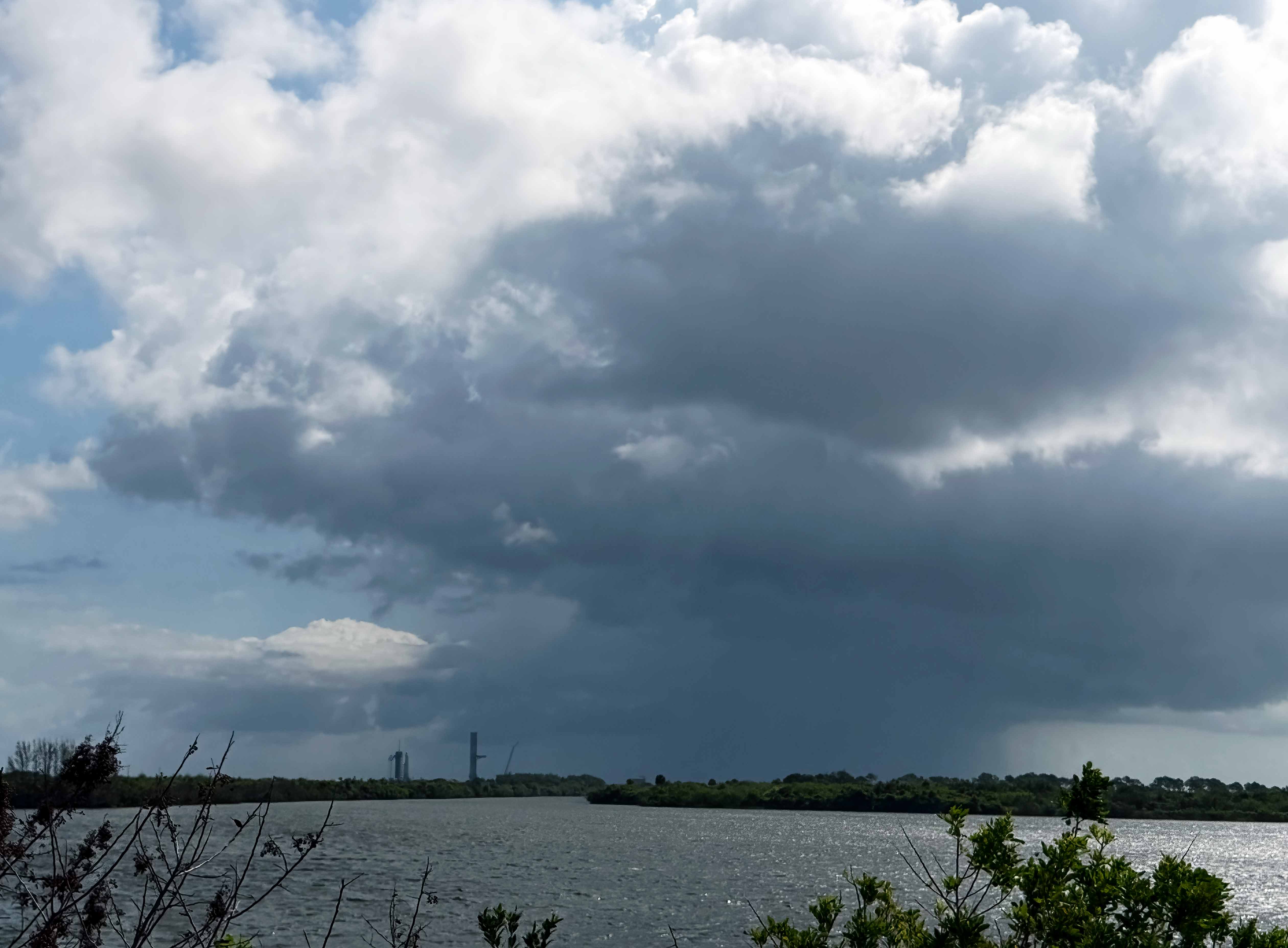
A planned Space Coast doubleheader produced a split outcome Monday, with United Launch Alliance pulling off its fastest-ever Atlas V turnaround in the evening even as SpaceX stood its Falcon Heavy down in the morning as a solitary shower lingered to the southeast of the launch pad, violating range weather rules. As always, the only thing predictable about Florida’s weather is that it is unpredictable. As the Space Coast moves into the first days of its wet season, it can rain anytime, anywhere, and sometimes under one single black cloud.

Showers Stop SpaceX

SpaceX called off liftoff in the final minute of the count, standing down a mission that would have ended the heavy-lifter’s longest hiatus since its 2018 debut.
The rocket, carrying Viasat’s third and final ViaSat-3 broadband satellite, had been set to lift off from Launch Complex 39A at 10:21 AM EDT, the opening of an 85-minute window. Forecasters with the 45th Weather Squadron had said the odds of acceptable conditions at 70 percent earlier in the morning, with cumulus cloud and surface electric field rules flagged as the chief concerns. A Carolina Low pushing a weak back door cold front across central Florida overnight kept those constraints in play through the count, and finally, with less than 60 seconds left, SpaceX called it a day.
“Vehicle and payload remain healthy,” SpaceX said in a post on X confirming the scrub. A new target date is Wednesday April 29, with the launch window opening at 10:13 AM. EDT.
ULA Launches Atlas V on the Amazon Leo-6 Mission

Over at Launch Complex 41, United Launch Alliance had far better weather conditions later as the dusk faded into the night. They launched an Atlas V 551 at 8:53:30 PM EDT, sending another 29 broadband satellites toward low Earth orbit for the Amazon Leo constellation. ULA confirmed deployment of all 29 spacecraft shortly after.

The Atlas V flight, designated Amazon Leo 6 by ULA and Leo Atlas 6 by Amazon, came just 23 days after the company’s last mission from the same pad, when Leo 5 launch that lifted off in the early hours of April 4th. The cadence reflected a deliberate effort to compress the launch campaign: ULA executed a streamlined roll-to-launch flow on a single calendar day, leaving the Vertical Integration Facility Monday morning and reaching the harddown milestone at 7:19 AM EDT before fueling and counting straight into the evening window.
Monday’s flight was the 108th launch of an Atlas V overall, the 100th conducted under ULA, and the sixth dedicated to Amazon Leo. Including this mission, ULA has now delivered 168 satellites toward the constellation. The 18-ton payload tied the record for heaviest cargo ever flown by an Atlas V — a mark first set just over three weeks ago by Leo 5. The 205-foot-tall rocket flew on a northeasterly trajectory in its 551 configuration, with five strap-on solid rocket motors and a medium-length payload fairing.
Launch Replay
Next Launch
| Details | |
|---|---|
| Mission | Falcon Heavy | ViaSat-3 F3 (ViaSat-3 Asia-Pacific) — Go for Launch! |
| Organization | SpaceX |
| Customer / Payload Provider | Viasat |
| Location | Kennedy Space Center, FL, USA |
| Rocket | Falcon Heavy |
| Pad | Launch Complex 39A |
| Status | Go for Launch |
| Status Info | Current T-0 confirmed by official or reliable sources. |
| Window Opens | Wednesday, 04/29/2026 10:13 AM |
| Window Closes | Wednesday, 04/29/2026 11:38 AM |
| Destination | Geostationary Transfer Orbit |
| Mission Description | ViaSat-3 is a series of three Ka-band satellites expected to provide vastly superior capabilities in terms of service speed and flexibility for a satellite platform. Each ViaSat-3 class satellite is expected to deliver more than 1 Terabit per second of network capacity, and to leverage high levels of flexibility to dynamically direct capacity to where customers are located. |
| Broadcast Start Time | Coverage typically begins ~15 minutes before launch. |
| SpaceX Streaming Coverage | Watch Live on SpaceX.com |
| Spaceflight Now YouTube Coverage | Watch on YouTube – Spaceflight Now Live Stream |
As of Sunday, April 26, 2026. Launch times are subject to change or cancellation at any time. Consult SpaceX.com for more information.

Author: Charles Boyer
NASA kid from Cocoa Beach, FL, born of Project Apollo parents and family. I’m a writer and photographer sharing the story of spaceflight from the Eastern Range here in Florida.

Leave a Reply