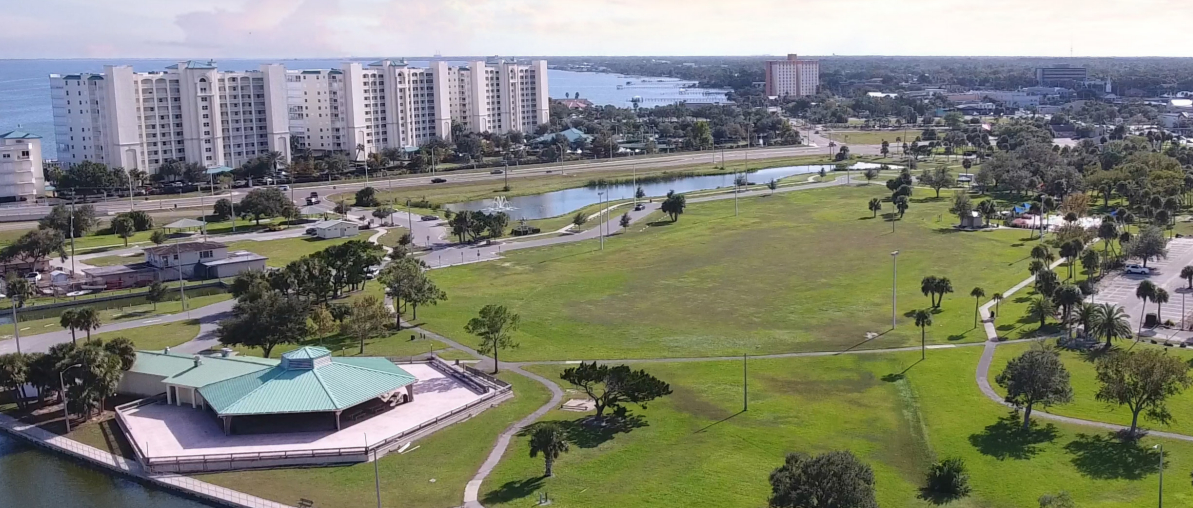


The Space Launch System rocket carrying the four-person Artemis II crew will lift off from Kennedy Space Center’s Launch Complex 39B no earlier than Wednesday at 6:24 PM. EDT, and for the hundreds of thousands of spectators expected to line the Indian River waterfront and surrounding parks, knowing what to watch for — and when — can be the difference between a confusing fireball in the sky and a fully understood, deeply felt moment of history.

Here is what you need to know, from the first flash of ignition to the moment SLS fades to a point of light over the Atlantic.
Artemis II Spectator Timeline
Space View Park, Titusville — ~12 miles from LC-39B. Visual events assume clear skies.
| T+ | Event | What to Expect |
|---|---|---|
| Liftoff & Ascent | ||
| 0:00 | Liftoff | Brilliant white flash, stack rises in complete silence. Sound is nearly a minute away. |
| ~0:08 | Tower Clear | SLS clears the Fixed Service Structure and flies free. |
| ~0:33 | Roll Maneuver | Slow rotation of the stack as it aligns to its northeast flight azimuth. |
| Sound & Max Q | ||
| ~0:57 | Sound Arrives | Rumble, crackle, and pressure wave cross the Indian River. Felt in the chest. The vehicle is already well downrange. |
| ~1:05 | Max Q | Peak aerodynamic pressure. Engines briefly throttle down. Exhaust plume may shift shape. |
| Major Visual Events | ||
| ~2:12 | SRB Separation | Two bright flashes as boosters tumble away. Vehicle looks slimmer. Under clear skies, the most dramatic moment of the ascent. Binoculars recommended. |
| ~3:24 | LAS Jettison | Small secondary flash atop Orion under clear skies. Crew is now past the abort window and committed to orbit. |
| Fade to Point of Light | ||
| ~5:00–6:00 | Naked-Eye Horizon | SLS becomes a bright moving point of light arcing northeast. Binoculars helpful. |
| ~8:00 | MECO | RS-25 engines shut down. Exhaust signature dims. Vehicle is a faint dot. |
| ~8:16 | Core Stage Sep | Core stage separates from ICPS. Not visible from the ground. |
| Beyond Visual Range | ||
| ~18:00 | ICPS / TLI Setup | Orion coasts toward translunar injection burn, hours away. Well beyond any ground view. |
Times are approximate mission elapsed time (T+). Visual events assume clear skies. Highlighted rows = top spectator moments.
Liftoff: The First Thing You’ll Notice Is A Bright Silence
At T+0:00, all four RS-25 engines and the two solid rocket boosters ignite simultaneously at the pad. You’ll see the smoke and steam of the solid rocket engines billowing up into a cloud, then the stack will begin to rise in a blaze of white light.
From Space View Park and the Titusville riverfront, roughly 12 miles from LC-39B, you will see all of it in complete silence. Sound travels at approximately one mile every five seconds, and across 12 miles of Indian River, that adds up to nearly a minute of delay. Do not expect noise when the rocket moves. Expect it when the rocket is already well underway and high the sky.
At about T+0:08, SLS clears the Fixed Service Structure and flies free. Watch for the vehicle rising above the launch complex silhouette — it is at this point that the full scale of the rocket begins to register against an open sky. Seconds later, at around T+0:33, the vehicle will execute a roll maneuver to align itself with its proper flight azimuth, visible as a slow, deliberate rotation of the stack. SLS will then arc northeast, over the Atlantic.

The Sound Arrives at About T+0:57 At Space View Park
Artemis II: When Does the Sound Arrive?
Sound delay from LC-39B by location. Based on speed of sound in warm Florida air (~346 m/s / 1,135 ft/s). Landmark coordinates sourced from OpenStreetMap.
| Delay | Miles | Km | Location |
|---|---|---|---|
| ~1 sec | 0.2 mi | 0.3 km | LC-39B Pad PerimeterRestricted — no public access |
| ~15 sec | 3.3 mi | 5.4 km | Apollo/Saturn V Center, KSCClosest ticketed public viewing to the pad |
| ~27 sec | 5.9 mi | 9.5 km | Playalinda Beach, Canaveral National SeashoreClosed during Artemis II launch |
| ~53 sec | 11.3 mi | 18.2 km | Space View Park, TitusvilleBest free public viewing on the Space Coast |
| ~71 sec | 15.3 mi | 24.6 km | Jetty Park, Port CanaveralDay passes sold out for Artemis II |
| ~92 sec | 19.9 mi | 32.0 km | Cocoa Riverfront ParkSouth Brevard County waterfront |
| ~3 min 36 sec | 46.3 mi | 74.6 km | Downtown OrlandoSound may be faint or inaudible at this range |
Distances measured from LC-39B, Kennedy Space Center. Speed of sound varies with temperature and humidity; figures assume ~85°F Florida air. Landmark coordinates sourced from OpenStreetMap.
When it comes, there is nothing quite like it. The initial sound arrival from SLS is not simply loud, it is physical. A low-frequency rumble and crackling roar will cross the Indian River and be felt in the chest before it is fully processed by the ears. The vehicle is already well downrange by the time sound reaches Titusville’s waterfront parks. Expect conversation to become impossible for 20 to 30 seconds, or longer, if the weather is just right.
At around T+1:05, SLS passes through Max Q — the moment of maximum aerodynamic pressure. Visually, little changes at this distance, though the exhaust plume may briefly shift shape as the RS-25 engines throttle down and then back up through the pressure spike.
SRB Separation Is the Spectator Event of the Ascent
At approximately T+2:12, the two solid rocket boosters separate from the core stage. From the ground, this appears as two brief, bright flashes on either side of the vehicle as the spent boosters tumble away. The core stage continues on its slimmer profile, with only the four RS-25 main engines burning. Binoculars are highly recommended from this point forward. The vehicle will be a bright, fast-moving object climbing steeply over the horizon.
At T+3:24, the Launch Abort System tower fires off the top of the Orion spacecraft — look for a small secondary flash above the vehicle. The jettison carries significance beyond the visual: once the LAS is gone, the four-member Artemis II crew — Commander Reid Wiseman, Pilot Victor Glover, Mission Specialist Christina Koch, and Canadian Space Agency Mission Specialist Jeremy Hansen — is past the abort window and fully committed to orbit.

From There, SLS Becomes a Moving Star
Between T+5:00 and T+6:00, SLS will be visible to the naked eye as a very bright, fast-moving point of light, similar in appearance to a satellite but far brighter and climbing on an arc rather than a flat trajectory. At approximately T+8:00, the RS-25 engines shut down at Main Engine Cutoff, and the exhaust signature dims. Sixteen seconds later, the core stage separates from the Interim Cryogenic Propulsion Stage carrying Orion. Neither event will be visible from the ground at this distance. The vehicle is, at that point, a memory.

What to Bring and Where to Stand
Binoculars are the most useful piece of equipment a spectator can bring, besides their phone, bug spray and sunscreen.
You won’t necessarily need binoculars for liftoff, which is vivid enough at a distance, but you will for the SRB separation at T+2:12 and the subsequent climb phase.
Given the roughly 400,000 visitors expected on the Space Coast, plan to be in position well before the launch window opens. For information on the best free public viewing spots in Titusville and along the Space Coast — including Space View Park, Rotary Riverfront Park, Kennedy Point Park, and ticketed options at Kennedy Space Center Visitor Complex — see our complete guide to Artemis II viewing locations.
Post-launch traffic will be severe across all major Space Coast corridors, with law enforcement managing one-way flow on US-1, SR-528, SR-520, A1A, and SR-407. Planning to stay put for an hour or more after liftoff is advisable. For the full Brevard County traffic management plan, see our Brevard County post-launch traffic plan coverage.
Artemis II is the first crewed flight of SLS and Orion, and the first time human beings have traveled beyond low Earth orbit in more than 50 years. The window opens at 6:24 p.m. EDT Wednesday, April 1, and extends for two hours.


Author: Charles Boyer
NASA kid from Cocoa Beach, FL, born of Project Apollo parents and family. I’m a writer and photographer sharing the story of spaceflight from the Eastern Range here in Florida.


Leave a Reply