

Blue Origin has laid out how it intends to return its New Glenn rocket to flight after the May 28 explosion that destroyed a vehicle and gutted much of Launch Complex 36 at Cape Canaveral Space Force Station.

In a June 30th update posted to its website and social media, CEO Dave Limp described a rebuilt launch process and reaffirmed the company’s target of resuming launches by the end of 2026. The plan will utilize a redesign the company was already developing, and it lets Blue Origin skip replacing one of the largest pieces of hardware lost in the blast.
Additionally, Space News reporter Jeff Foust posted notes of comments on X.com made by the Senior Vice President of Lunar Permanence at Blue Origin, John Couluris, over the weekend at the Spacetide conference regarding the timelines of the rebuild: the rebuilt LC-36A will be ready by end of this year. Additionally, by late 2027 Blue Origin expects to have new LC-36B pad in service.
The cause is still under investigation
More than a month after the incident, Blue Origin still has not identified what caused the failure and subsequent explosion of its New Glenn vehicle late this spring. The May 28 anomaly occurred during a hotfire test of an integrated New Glenn vehicle, with both stages loaded with liquid methane and liquid oxygen while the rocket remained bolted to the pad. As the seven BE-4 engines throttled up, a fire broke out at the base of the booster and the rocket was consumed in a fireball that was felt in many corners of the Space Coast.
Limp said the company continues to actively investigate the cause and that early analysis points to the aft section of the first stage. He noted the vehicle was heavily instrumented, with data from multiple sensors and camera angles, which the company believes will let it identify and correct the root cause. Beyond pointing to that aft section, Blue Origin has not released details on what went wrong. No injuries or fatalities resulted from the blast.


Meanwhile, United Launch Alliance, who uses the BE-4 as part of its new Vulcan rocket, is preparing a Vulcan for its own return to flight after it too experienced a major anamoly — the loss of the nozzle of one of Vulcan’s GEM-63XL solid rocket boosters during ascent. On May 13, ULA hoisted the first Vulcan booster inside its newly finished Vertical Integration Facility – Amazon (VIF-A) near SLC-41 at Cape Canaveral.
How, or even if, Vulcan and BE-4 operations may be affected by the New Glenn failure remains unresolved.
A different pad, not the same one rebuilt
Rather than restore Launch Complex 36 to its prior configuration, Blue Origin is moving to what it calls a horizontal-vertical hybrid concept of operations. The company said it had already been developing this approach for the larger 9×4 version of New Glenn. Under the new process, the first and second stages are mated horizontally inside the integration facility next to the pad, then transported to the base of the pad itself.
A crane then hoists the rocket into a vertical orientation and lowers it onto a refurbished launch table, where it mates to the hold-down ring. Blue Origin described this as the reverse of the operation already used to offload the booster from its recovery ship. The payload is lifted separately and placed atop the vehicle, after which the crane clears the pad ahead of a launch attempt.

A crane then hoists the rocket into a vertical orientation and lowers it onto a refurbished launch table, where it mates to the hold-down ring. Blue Origin described this as the reverse of the operation already used to offload the booster from its recovery ship. The payload is lifted separately and placed atop the vehicle, after which the crane clears the pad ahead of a launch attempt.
What survived, and what it means for the schedule
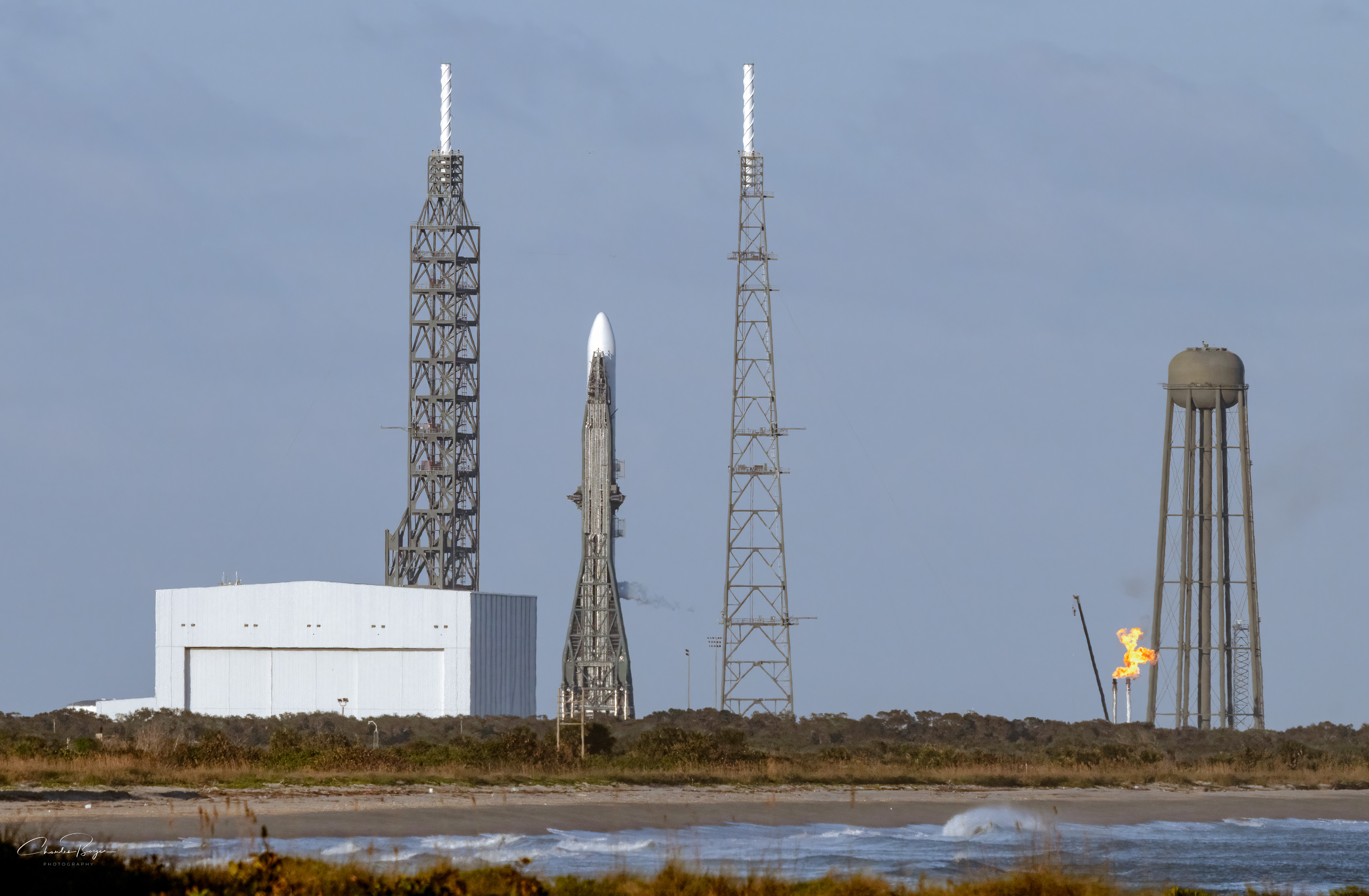
Blue Origin said the damage was less severe than first feared. The tank farm, the integration facility, the vehicle access tower and the water tower came through in good shape. The twice-flown and twice-landed Never Tell Me the Odds GS-1 first stage and three second stages that were housed in the integration facility also survived and have been relocated back to Blue’s factory across from Kennedy Space Center Visitors Center. The company said hardware recovery and debris removal are complete and that reconstruction of the pad at LC-36 has begun.
The stakes reach well beyond a single pad. Launch Complex 36 is currently Blue Origin’s only pad capable of supporting New Glenn, and the rocket is central to NASA’s plans for its Blue Moon landers. NASA Administrator Jared Isaacman said Blue Origin was very committed to resuming launches by the end of 2026 and described the recovery progress as almost beyond impressive. He also said the agency is decoupling the lander from the launch vehicle, exploring whether the first Blue Moon Mark 1 cargo lander could fly on a rocket other than New Glenn.
For now, the return-to-flight plan and the investigation are running in parallel. Blue Origin has committed to a timeline prior to finalizing the root cause(s) of New Glenn’s failure. While that report may never be released to the public, it is of great interest to the US Space Force as well as Blue Origin’s commercial customers. The company said it will provide updates as it learns more.

Author: Charles Boyer
NASA kid from Cocoa Beach, FL, born of Project Apollo parents and family. I’m a writer and photographer sharing the story of spaceflight from the Eastern Range here in Florida.


Leave a Reply