

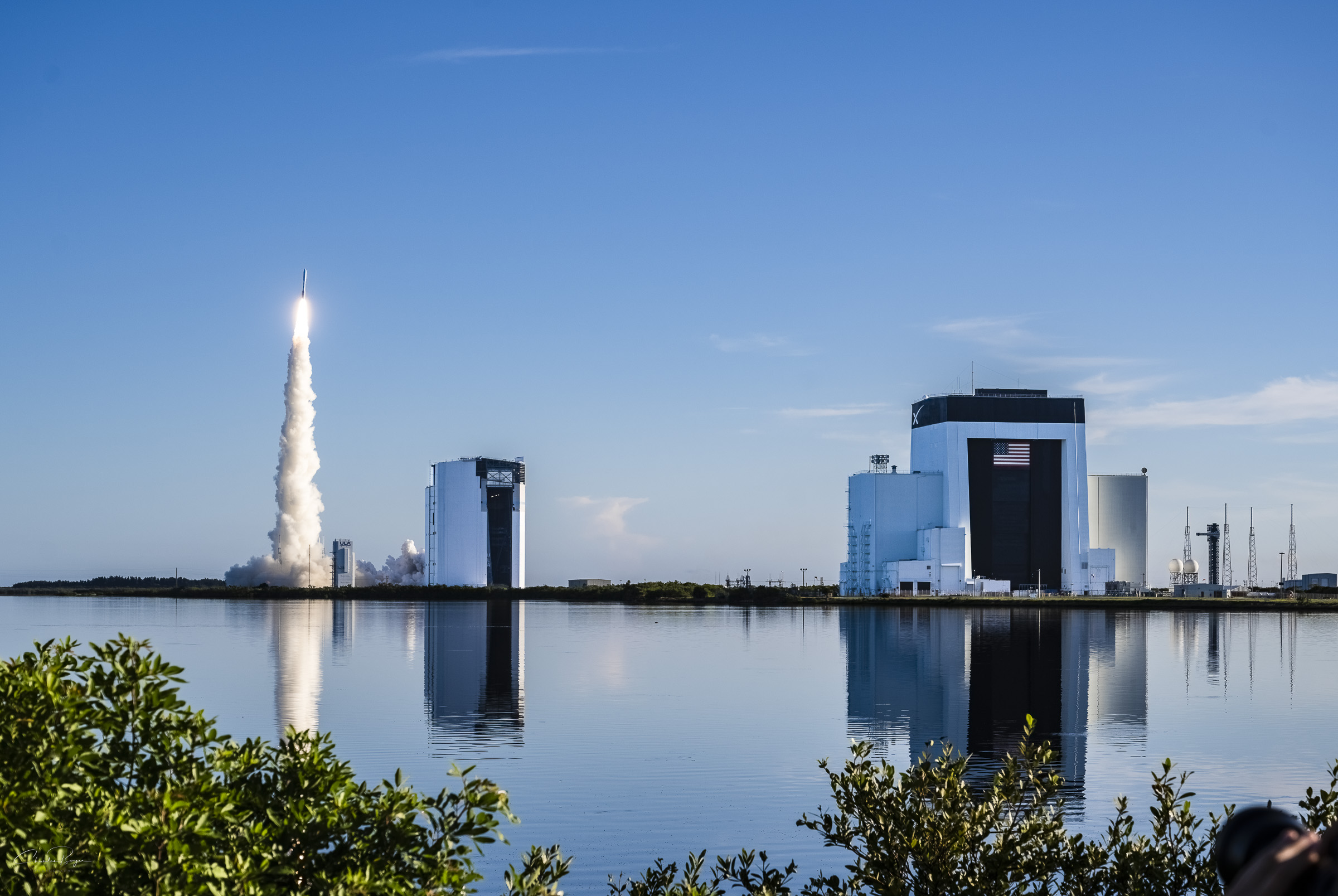
Photo: Charles Boyer / Talk of Titusville
As October progresses, Blue Origin has turned up the tempo of its preparations for the next launch of its New Glenn rocket. Plans are converging toward a liftoff sometime between mid-October and mid-November for the second mission of the 322-foot-tall (98-meter) rocket, which will carry NASA’s twin Rocket Lab-built ESCAPADE probes and place them on their way to Mars.

Though the company has not yet committed to a hard launch date, recent public statements suggest the first-stage static fire is likely to occur in the middle of the month, with a launch to follow soon thereafter. All of the pieces are coming together for a second New Glenn flight.
In a post on social media, Blue Origin affirmed that “ESCAPADE is at Astrotech and GS1 [the first stage] is headed to LC-36 in early October,” adding that the “vehicle hotfire mid-month” is the next major activity. Given that today is October 2, “mid-month” is only a couple of weeks away.
That phrasing strongly implies that the full booster test—igniting all seven BE-4 engines while the booster is held on the pad—is expected in mid-October. Assuming a successful test firing of GS1, the entire launch vehicle will then be stacked and returned to LC-36 for its eventual flight to space.
Meanwhile, the second stage of the vehicle has already undergone a dedicated hot-fire test on September 23, a milestone that cleared that portion of the stack for upcoming integration work.
This campaign comes in the wake of New Glenn’s inaugural flight in January 2025, which successfully placed the Blue Ring pathfinder payload into orbit but failed to recover the booster.
After NG-1, Blue Origin and the FAA jointly reviewed propulsion and re-entry performance and identified corrective measures, especially concerning propellant flow and engine re-ignition control. In March, the FAA released its findings and a list of items that were required to be remediated and verified before a second launch.
FAA Licensing
The FAA already licenses New Glenn Flight 2 under Blue Origin’s existing five-year Part 450 commercial space launch license, issued in December 2024 and valid through at least 2029. No separate license is required for subsequent flights under this framework, provided that Blue Origin meets the changes required after NG-1’s flight and subsequent investigation.
This license authorizes multiple orbital missions from Cape Canaveral Space Force Station (LC-36), including reusability attempts for the first stage on an Atlantic barge. It covers Flight 2 following the closure of the Flight 1 mishap investigation in March 2025.

Pretty clearly, business is picking up for Blue Origin. Sooner rather later, skies above the Space Coast are going to turn blue again as NG-2 powers its way to orbit. And may the odds ever be in their favor.

Author: Charles Boyer
NASA kid from Cocoa Beach, FL, born of Project Apollo parents and family. I’m a writer and photographer sharing the story of spaceflight from the Eastern Range here in Florida.



Leave a Reply