
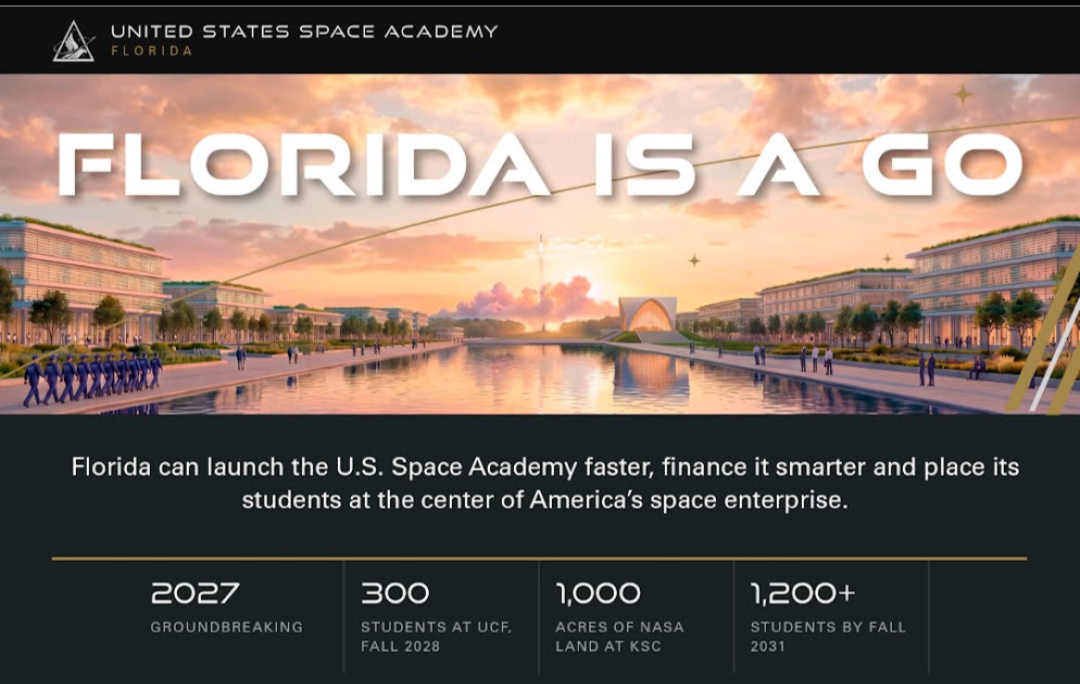
Space Florida’s plan calls for a 300-student launch at UCF in 2028 and a permanent Space Coast campus serving at least 1,200 students by fall 2031.
Florida’s proposal to host the United States Space Academy would bring a permanent campus to Kennedy Space Center, with students initially attending classes at the University of Central Florida while the Space Coast facilities are developed.

Materials released by Space Florida on Tuesday, November 17, outline a phased approach: groundbreaking in 2027, an inaugural class of 300 students at UCF in fall 2028, and a permanent campus on 1,000 acres of NASA land at Kennedy Space Center with capacity for at least 1,200 students by fall 2031.

The announcement presents Florida’s case for hosting the academy. It does not announce a final federal site selection or establish that the proposed campus has received all necessary approvals.
Starting at UCF, Building Toward Kennedy Space Center
Under Florida’s proposal, the academy would begin as a distinct college at UCF, supported by Embry-Riddle Aeronautical University and the Space University Research Consortium. That arrangement would allow the first students to begin their education before the permanent Kennedy Space Center campus is ready.

Space Florida proposes making the KSC site available through an amendment to its existing Launch and Landing Facility property agreement with NASA. The announcement describes that amendment as a step needed to accommodate the academy, rather than an already completed land transfer.
The proposed schedule pairs a 2027 groundbreaking with the temporary university-based launch, allowing campus development and the academy’s initial operations to move forward on parallel tracks.
Florida’s Pitch: Train Where Space Operations Happen
The announcement’s central argument is that Florida can place students close to the nation’s active launch and spaceflight operations.
“Florida can launch the U.S. Space Academy faster, finance it smarter and place its students at the center of America’s space enterprise,” the promotional material states.
Space Florida points to Kennedy Space Center, Cape Canaveral Space Force Station and the commercial companies operating along the Space Coast as the foundation of that pitch. Its proposal emphasizes the opportunity for students to train near both national-security and commercial-space operations.
For North Brevard, the proposed permanent location makes the announcement more than a statewide education initiative: Florida’s plan would place the academy at Kennedy Space Center. However, the materials do not identify an exact parcel, campus entrance or detailed construction footprint.
A Mix of Infrastructure Support and Financing
Space Florida’s proposal outlines several potential ways to support the campus rather than presenting a single, fully funded construction budget.
The announcement cites more than $600 million Florida says it has already invested in space transportation infrastructure. It also identifies the Florida Department of Transportation’s State Work Program and the Space Florida Spaceport Improvement Program as possible sources of support for roads and site infrastructure.
For academy buildings, Space Florida points to lease-purchase agreements, ground leases and public-private partnerships. It describes its work with NASA at the former Shuttle Landing Facility as a model for that approach.
The materials do not provide a total academy development cost or identify a complete package of committed funding. The previously invested infrastructure money should not be confused with a new appropriation specifically for the academy.
A Proposal, Not Yet a Site-Selection Announcement
While the announcement carries the headline “Florida Is a Go,” its details describe how Florida proposes to deliver the academy—not confirmation that the state has been selected to host it.
Key questions remain about federal selection, the proposed NASA property agreement, final financing and the scope of the permanent campus.
For Titusville and the surrounding Space Coast, the proposal puts a significant educational institution on the region’s potential development map. Whether that vision advances will depend on the decisions and agreements needed to turn Florida’s pitch into an approved project.


Leave a Reply