

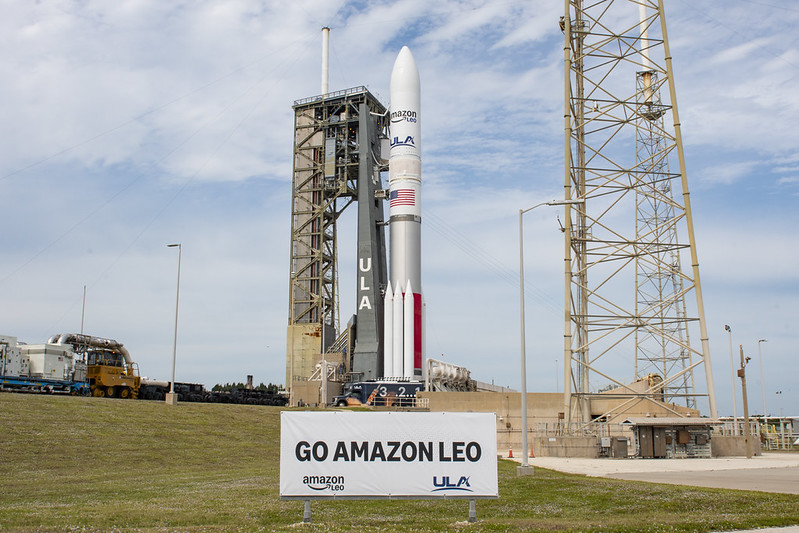
United Launch Alliance moved a Vulcan to the launch pad at SLC-41 today, and began the final preparations prior to a planned launch early tomorrow afternoon. The launch window opens at 12:54 PM EST, and closes 29 minutes later at 1:23 PM.
Returns To Flight
This is Vulcan’s Return To Flight after the Northrop Grumman GEM-63XL solid rocket booster structure experienced an anomaly during the previous Vulcan flight, USSF-87, in February. While that mission was ultimately successful, one of the four solid rocket boosters experienced a structural issue and lost its nozzle, leading to Vulcan being grounded until now.
Another less-discussed aspect of tomorrow’s launch is that the mission is also the return-to-flight mission for Blue Origin’s BE-4 engine. In May, a catastrophic explosion during a static fire of New Glenn originated at the main oxygen valve on one of the first-stage BE-4 engines, leading to a complete loss of the rocket and severely damaging Blue Origin’s launch facilities at Pad 36A. ULA uses two BE-4 engines on its Vulcan core booster, and this launch will mark the return to action for a critical piece of two rockets for two companies.
In short, a lot is riding on Amazon Leo 1. ULA needs Vulcan flying regularly to work through the large backlog of missions on its books. Another misfire would shake customer confidence and could send some of those planned missions to other launch providers, leading to a significant loss of revenue for the company.
For its part, Blue Origin has a lot riding on the BE-4 performing as expected during this mission. Blue needs BE-4 for New Glenn, and New Glenn is needed for a number of missions for Artemis.
At A Glance
| Mission | Amazon Leo (LV-01) |
|---|---|
| Organization | United Launch Alliance (ULA) |
| Rocket | Vulcan VC6L |
| Launch Site | Cape Canaveral Space Force Station, Florida |
| Launch Pad | Space Launch Complex 41 (SLC-41) |
| Launch Status | GO FOR LAUNCH |
| Status Information | Current T-0 confirmed by official or reliable sources. |
| Window Opens |
Friday, November 13, 2026 12:54 PM EST |
| Window Closes |
Friday, November 13, 2026 1:23 PM EST |
| Launch Window Duration | 29 minutes |
| Destination | Low Earth Orbit (LEO) |
| Mission Description |
Amazon Leo, formerly Project Kuiper,
is Amazon’s planned satellite
constellation providing broadband
internet access from low Earth orbit.
Operated by Amazon subsidiary Kuiper Systems LLC, the original constellation design consists of 3,276 satellites distributed across 98 orbital planes at altitudes of approximately 590, 610, and 630 kilometers. The Vulcan VC6L is planned to carry 45 satellites on this mission. |
| Launch Coverage |
United Launch Alliance
Official mission updates and launch coverage. |
Weather Forecast
The 45th Weather Squadron of Space Launch Delta 45 has released their official Launch Mission Execution Forecast for tomorrow’s planned flight of Vulcan: 90% Go through the launch window. The squadron’s meteorological team will continue to monitor conditions during the countdown to liftoff.

Payload
Forty Amazon Leo broadband satellites make up the payload for LV-01, short for Leo Vulcan 1, the biggest batch of Leo spacecraft sent up on a single rocket so far. The stack rides inside a 70-foot-tall fairing and was prepared in VIF-A, a new integration building Amazon paid for at the Cape.
Launch Viewing Guide: Vulcan From SLC-41
United Launch Alliance plans to launch Vulcan VC6L on the Amazon Leo LV-01 mission Friday, Nov. 13 from Space Launch Complex 41 at Cape Canaveral Space Force Station. The window opens at 12:54 p.m. EST and closes at 1:23 p.m. It is Vulcan’s first flight since Feb. 12 and the first with six solid rocket boosters, the rocket’s most powerful configuration.
Live Streams
ULA livestream: Vulcan Leo 1 – YouTube
The launch broadcast will begin at 12:34 p.m. EST
MaxQ: https://www.maxq.app/launches/vulcan-vc6l-amazon-leo-lv-01
Spaceflight Now: https://www.youtube.com/@SpaceflightNowVideo
Stream should start one hour prior to launch.
NASA Spaceflight: https://www.youtube.com/@NASASpaceflight
Stream should start one hour prior to launch
Viewing In Person
The Short Version:
For a direct view of liftoff, the best free spots are the pull-offs on SR-528 near the Banana River Bridge and the southern Titusville parks on US-1, Kennedy Point Park and Rotary Riverfront Park. Jetty Park is a good paid option with amenities. Cocoa Beach and the northern Titusville parks are farther away but still offer a fine view once the rocket climbs.
The closest public spot is Playalinda Beach, if it is open. Check with the National Park Service before you drive out.
A midday launch means every public park and beach on this list is open. Here is where to go and what to expect.
LAUNCH VIEWING: Vulcan From SLC-41
| Area | Spot | Distance to SLC-41 | Notes |
|---|---|---|---|
| Canaveral National Seashore | Playalinda Beach (Lots 1 and 2) | ~5 to 6 mi | Closest public beach. Entry fee. Arrive at least two hours early because rangers stop entry once the lots fill. Dunes can block the first seconds, so walk to the shoreline. Cell service is spotty. |
| Port Canaveral | SR-528 causeway pull-offs near the Banana River Bridge | ~10 to 11 mi | Free. Open views across the water with liftoff generally unobstructed. Unimproved pull-offs, so drive slowly and park well off the travel lanes. Bring chairs. |
| Port Canaveral | SR-401 and the Port waterfront | ~10 to 12 mi | Free. Sightlines toward the pads, but port structures or cruise ships can block liftoff. |
| Port Canaveral | Jetty Park (pier and beach) | ~11 to 12 mi | Park fee, purchased in advance. A berm on the Cape hides the pad, so the rocket appears five to 10 seconds after liftoff. Cruise ships can also get in the way. The pier has the best view. Restrooms and concessions. |
| Titusville / US-1 | Max Brewer Bridge and Parrish Park | ~11 to 13 mi | Free. Elevated vantage with liftoff generally unobstructed. Fills quickly. |
| Titusville / US-1 | Space View Park | ~12 to 14 mi | Free. Riverfront views with liftoff generally unobstructed. Occasional audio feeds. Good parking. |
| Titusville / US-1 | Rotary Riverfront Park | ~12 to 14 mi | Free. Open Indian River views with liftoff generally unobstructed. Moderate parking. |
| Titusville / US-1 | Kennedy Point Park | ~12 to 14 mi | Free. Long riverfront by the marina with liftoff generally unobstructed. Good tripod space. |
| Cape Canaveral (city) | Cherie Down Park | ~12 to 13 mi | Free beach access with restrooms. Small lot, so arrive a couple of hours early. Dunes and vegetation can block the first seconds unless you are at the shoreline. Less crowded than Jetty Park. |
| Cocoa Beach | Cocoa Beach Pier | ~15 to 17 mi | Paid parking. Unobstructed horizon view with food and restrooms. Tourist crowds. |
| Cocoa Beach | Alan Shepard Park | ~16 to 18 mi | Paid parking. Beachfront with restrooms. Liftoff generally unobstructed from the shoreline. |
| Cocoa Beach | Lori Wilson Park | ~17 to 18 mi | Free parking. Large beachfront with restrooms, boardwalks and unobstructed views. |
If You Go, Here’s What To Expect
You will see it before you hear it. Sound takes about five seconds per mile to reach you. From most spots on this list, that means close to a minute of silence after liftoff. The ground will not shake and you will not feel heat, even at the closest sites.
No booster landing and no sonic boom. Vulcan’s first stage is not recovered. Once the rocket is out of sight, the show is over.
Six solid rocket boosters. This is the first Vulcan to fly with six.
The stream is behind the rocket. Online broadcasts run five to 15 seconds behind the real countdown. Use them for status updates, but keep your eyes on the horizon as the clock nears zero.
Tips for Launch Day
Arrive early. The window is only 29 minutes, so there is little room for delay. Parks fill and Port Canaveral traffic can be slow. Allow at least two hours for Playalinda.
Track the clock. United Launch Alliance updates its website within minutes of any change to launch time. Its webcast begins about 20 minutes before liftoff, and Spaceflight Now typically starts about an hour before. The free Next Spaceflight app has a countdown clock. It’s available on both Android and iPhone.
Plan for a scrub. Launches slip for weather and technical reasons. Hundreds of thousands of things must be in nominal condition while only one bad item can cause a scrub.
Mind the photographers. At Playalinda, launch photographers work from the dune boardwalks. Give them room near launch time. They are usually glad to talk afterward.
For more detail on each location, see the SLC-40 and SLC-41 viewing guide and the Playalinda launch viewing guide at Eastern Range. The full schedule is on the Talk of Titusville launch calendar.




Leave a Reply