
It’s currently not ready to fly, and that might take a while.

With news that SpaceX plans to retire its Crew Dragon sometime before 2030, focus has returned to the troubled Boeing Starliner CST-100 program. It may well come to pass that the troubled spacecraft is the only option NASA and private LEO space station operators have to rotate crews.


Starliner has not left the ground since June 2024, when its Crew Flight Test carried Butch Wilmore and Suni Williams to the International Space Station and left them to come home aboard a SpaceX Crew Dragon instead. More than two years later, the list of things standing between the capsule and its next launch is still substantial, and no launch date for its next flight has been announced.
SpaceX COO Gwynne Shotwell Makes Pointed Comments About Boeing
On a recent “All-In” podcast, SpaceX COO Gwynne Shotwell was asked whether SpaceX would keep flying Falcon 9 and Crew Dragon, NASA’s only operational U.S. crew taxi to the International Space Station. SpaceX has already begun winding down commercial Falcon 9 activities, and the company has told NASA it does not intend to fly Crew Dragon past 2030, ostensibly when ISS is retired and de-orbited.
In the video of the podcast linked above, starting around 16:30 into the discussion
“There is another provider, right? Boeing has been paid, I think probably more than we have been paid to develop their human capsule. So, we’re just going to let them have some business. They should fly their capsule. [The] government paid a lot of money for that. [laughter] They should be able to use it.” — SpaceX COO Gwynne Shotwell
In November 2025, NASA and Boeing modified the Commercial Crew contract: the next flight, Starliner-1, became a cargo-only mission, and the number of flights NASA is obligated to buy dropped from six to four, with two remaining as options. Rumor has it that NASA will pick up the options for the two extra CST-100 flights, but no official announcement has been made.

As this article was being written, NASA on Friday said it has awarded SpaceX a $946 million contract for three additional crewed missions to the International Space Station, extending the company’s crewed flights to the orbiting laboratory through 2030. No changes to SpaceX’s plans to retire Crew Dragon were announced.
Repairs Ongoing, With The Current Status Not Yet Public
The Starliner investigation report NASA released in February documented four distinct hardware anomalies, beginning with five service-module RCS thrusters that tripped their fail-off protection during rendezvous, causing a temporary loss of six-degrees-of-freedom control; four were recovered in orbit, which allowed docking.
Investigators at White Sands traced the failure to two-phase oxidizer flow and Teflon poppet extrusion inside the thruster valves, and found the original qualification testing had not accounted for the duty cycles a docking approach actually demands.
Separately, seven of eight helium manifolds on the service module leaked during the flight. Boeing’s corrective work — reported here in April 2025 — includes thermal barriers inside the doghouses, revised in-flight thruster pulse profiles, and new helium seal options per NASA. The next flight, Starliner-1, is intended to prove the fixes.
Talk of Titusville will always be free to access.
If you love what we’re doing, please consider becoming a monthly Supporter HERE.
A NASA Office of Inspector General report found that testing and analysis on the helium leaks and propulsion failures had not been completed as of March 2026, that no Starliner-1 launch date was scheduled, and that fall 2026 certification was unrealistic and is likely slipping to 2027. Both the OIG and the Aerospace Safety Advisory Panel noted that the thruster failures and doghouse heating remained unresolved.
NASA Playing It Safe After Starliner CFT Close Call

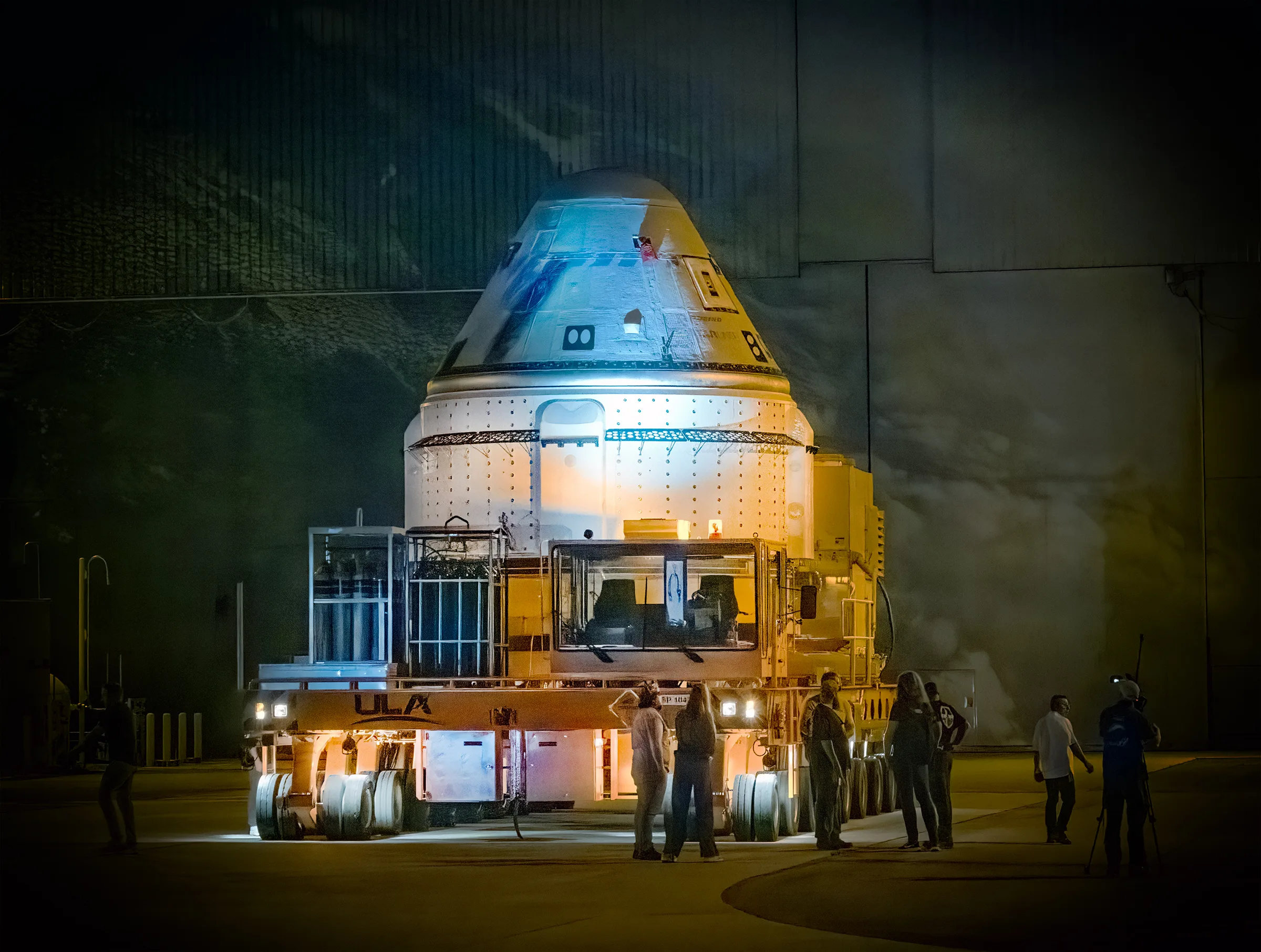
Photo: Charles Boyer
NASA will not fly another crew on Starliner until the technical causes are corrected, the propulsion system is fully qualified, and investigation recommendations are implemented, Administrator Jared Isaacman said in February. Even then, Starliner needs a berth: only two ISS ports, both on Harmony, are compatible, one typically holding a Crew Dragon and the other cargo vehicles.
Boeing CEO Kelly Ortberg told investors in July that the redesign work is going well, but that the company still has to align crewed and uncrewed launch plans with NASA, according to a report by NASASpaceflight. Boeing has told shareholders in its quarterly filing that it is targeting no earlier than the fourth quarter of this year for Starliner-1, but NASA has not confirmed that time frame. In short, there are quite a few reviews and approvals between Starliner-1 and SLC-41 where United Launch Alliance launches the Atlas V rockets that loft Starliner towards orbit.
In short, it looks like Starliner 1 won’t launch until late 2026 at the earliest, and many at NASA say that timeline is unrealistic. One thing is clear about Starliner, however: until other LEO “space taxi” options become available, NASA is going to have to rely on perhaps one of the most troubled programs in the entire history of crewed spaceflight.

Author: Charles Boyer
NASA kid from Cocoa Beach, FL, born of Project Apollo parents and family. I’m a writer and photographer sharing the story of spaceflight from the Eastern Range here in Florida.


Leave a Reply