


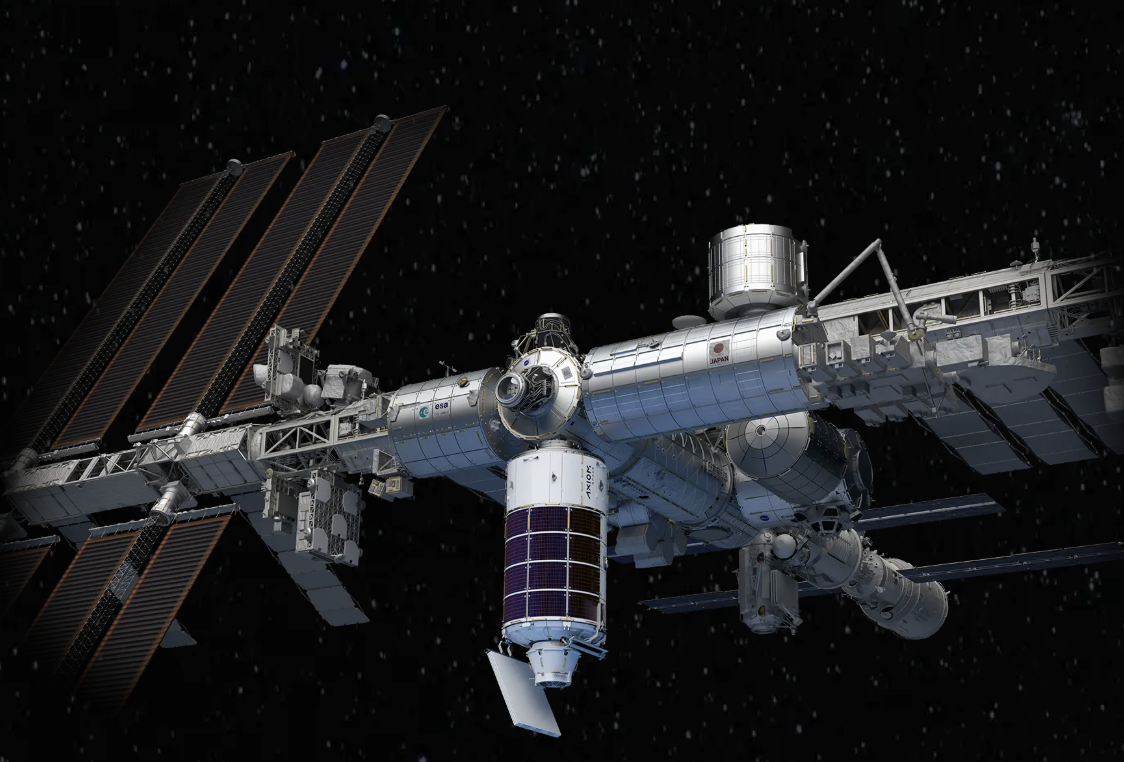
Graphic: Axiom Space
NASA released a draft request on Monday seeking proposals for the Commercial Low Earth Orbit Destination Contract. CLEODC will determine who builds and operates the space station(s) intended to succeed the International Space Station. The move restarts a competition that had been on hold for much of the past year.
Renting Space In Space
“Industry believes it can meet the timelines and that a viable commercial marketplace exists where NASA is one customer among many,” NASA Administrator Jared Isaacman said in announcing the draft.
The plan flips the model NASA used for decades. Rather than owning and running its own station, the agency intends to shift to a tenant model, buying services from commercial providers who develop, operate and maintain the stations themselves.
Contract Plans
NASA plans to award firm-fixed-price, multiple-award contracts on an indefinite-delivery, indefinite-quantity basis, covering development, certification and delivery of station services. The competition would be full and open under Federal Acquisition Regulation rules.
The agency expects to pick two or more companies for an initial development phase, then run a competitive task-order process for final design, testing, evaluation and certification. Providers would need to be ready to support a crewed flight test in 2029 as part of earning certification to fly NASA astronauts.

Potential Bidders

Graphic: Vast Space
Vast (Haven-1 / Haven-2) Vast aims to launch the first module of Haven-2 by 2028, then follow with three additional modules over a two-year period. The single-module Haven-1 is set to launch in early 2027 as an on-orbit proof of concept. The company raised its first outside funding round to accelerate Haven-2, having previously relied on founder Jed McCaleb’s roughly $1 billion. NASA also handed Vast its first Private Astronaut Mission in February, a credibility boost.
Axiom Space (Axiom Station) It is the only competitor to have already led commercial flights to the ISS, and is currently in the latter phases of developing the next-gen space suite, xEMU. Thales Alenia Space is welding and machining Axiom’s first module.

Starlab (Voyager Technologies + Airbus) The Starlab consortium chose SpaceX’s Starship to fly Starlab into orbit in one flight, with Northrop Grumman’s Cygnus handling resupply. Reaching full capacity in one launch could leapfrog the modular designs. Starlab has also reported selling out its commercial payload space despite being roughly three years from orbit.

Author: Charles Boyer
NASA kid from Cocoa Beach, FL, born of Project Apollo parents and family. I’m a writer and photographer sharing the story of spaceflight from the Eastern Range here in Florida.


Leave a Reply