

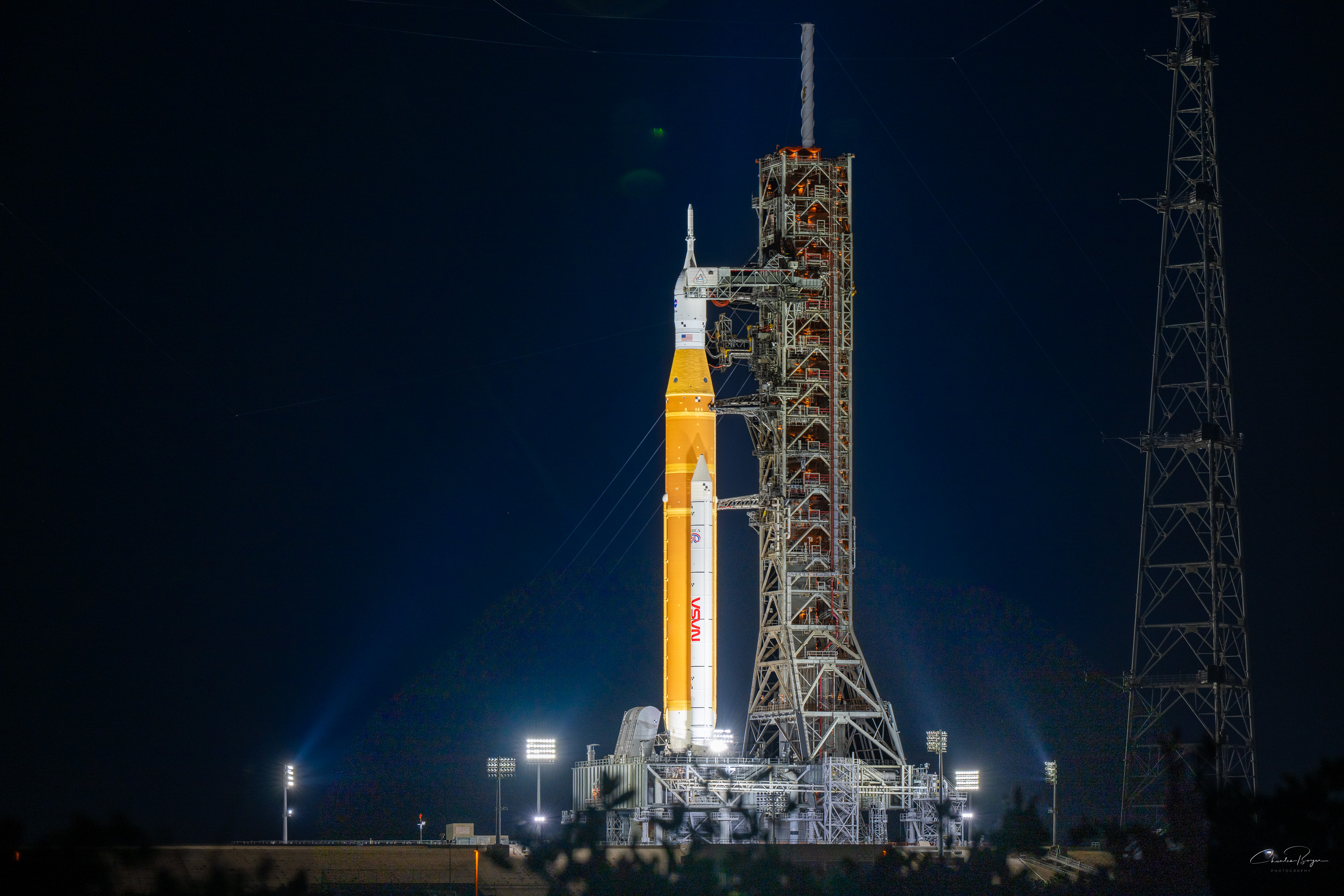
Photo: Charles Boyer
The countdown for the Artemis II Wet Dress Rehearsal is underway at Kennedy Space Center. Yesterday at 8:13 PM ET, or L-48:40 hours, the simulated countdown began in preparation for a test launch window opening at 9 PM tomorrow, February 2nd.
Artemis II will not launch during this countdown, of course, as it is just a test countdown. The Artemis II crew will not be aboard during Orion the WDR.
Sometime around 1 AM ET Tuesday, or February 3rd, the WDR will conclude.
What Comes After The WDR
After the test cycle concludes, engineers and mission managers will review data gathered during the Wet Dress Rehearsal. This process may take a few days as each major system is reviewed. Since Artemis I, NASA has implemented changes to the liquid Hydrogen systems at LC-39B. That will be a particular area of concern, as H2 leaks bedeviled the Artemis I countdowns both in WDR and later on the night it launched.
After the Data Review, a Flight Readiness Review can be held, during which all aspects of the mission are reviewed: the SLS rocket, the Orion spacecraft, ground systems at the Cape, and the status of the recovery teams that would be first responders to a major anomaly, should one occur, and many others.

The FRR is last major review for the flight, and in it, the Artemis II management team will need to give the mission permission to proceed towards a launch. Only after that milestone is achieved will a launch date and time be announced by NASA.

Photo: Charles Boyer
The Wet Dress Rehearsal In Detail
| L-49 Hours, 15 Minutes and Counting | |
|---|---|
| Time | Activity |
| L-49H 15M | Launch team arrives on stations; countdown begins |
| L-48H 40M | Countdown clock begins |
| L-48H 45M – L-39H 45M | LOX/LH2 system preparations for vehicle loading |
| L-47H 30M – L-38H 30M | Fill water tank for sound suppression system |
| L-40H 30M – L-39H | Interim Cryogenic Propulsion Stage (ICPS) powered up |
| L-39H 30M – L-38H 45M | Core stage powered up |
| L-38H 45M – L-34H 30M | Final preparations of four RS-25 engines |
| L-34 Hours, 30 Minutes and Counting | |
|---|---|
| Time | Activity |
| L-33H 45M – L-33H 10M | ICPS powered down |
| L-32H 30M – L-28H 30M | Charge Orion flight batteries to 100% |
| L-30H 30M – L-23H 30M | Charge core stage flight batteries |
| L-19H 30M – L-16H | Orion crew suit regulator leak checks |
| L-19H 15M – L-17H 45M | ICPS powered up for launch |
| L-15 Hours and Counting | |
|---|---|
| Time | Activity |
| L-14H 30M – L-13H | All non-essential personnel leave Launch Complex 39B |
| L-13H 15M – L-11H 05M | Air-to-GN2 changeover and vehicle cavity inerting |
| L-12H 45M – L-11H 15M | Ground Launch Sequencer (GLS) activation |
| L-11 Hours, 40 Minutes and Counting | |
|---|---|
| Time | Activity |
| L-11H 35M – L-9H 20M | Built-in hold: 2 hours, 15 minutes |
| L-11H 40M – L-10H 30M | Weather and tanking briefing |
| L-10H 20M | Go/No-Go decision to begin tanking |
| L-10H 20M – L-9H | Orion cold soak |
| L-10H 10M – L-9H 50M | Core stage LOX transfer line chilldown |
| L-10H 10M – L-9H 25M | Core stage LH2 chilldown |
| L-10 Hours and Counting | |
|---|---|
| Time | Activity |
| L-9H 50M – L-9H 10M | Core stage LOX main propulsion system chilldown |
| L-9H 25M – L-9H | Core stage LH2 slow fill start |
| L-9H 20M | Resume T-Clock from T-8H 10M |
| L-9H 10M – L-8H 55M | Core stage LOX slow fill |
| L-9H – L-7H 40M | Core stage LH2 fast fill |
| L-8H 55M – L-6H 10M | Core stage LOX fast fill |
| L-8H 45M – L-8H 10M | ICPS LH2 chilldown |
| L-8H 10M – L-7H 25M | ICPS LH2 fast fill start |
| L-7H 45M – L-6H | ICPS LOX main propulsion system chilldown |
| L-7H 40M – L-7H 30M | Core stage LH2 topping |
| L-7H 30M – terminal | Core stage LH2 replenish |
| L-7H 25M – L-7H 05M | ICPS LH2 vent and relief test |
| L-7H 05M – L-6H 55M | ICPS LH2 tank topping start |
| L-6H 50M – terminal | ICPS LH2 replenish |
| L-6H 10M – L-5H 40M | Orion communications system activated (RF to Mission Control) |
| L-6H 10M – L-5H 40M | Core stage LOX topping |
| L-6 Hours and Counting | |
|---|---|
| Time | Activity |
| L-6H – L-5H 15M | ICPS LOX fast fill |
| L-5H 40M – terminal | Core stage LOX replenish |
| L-5H 40M | Stage pad rescue; closeout crew assemble |
| L-5H 15M – L-5H | ICPS LOX vent and relief test |
| L-5H – L-4H 40M | ICPS LOX topping |
| L-4H 40M – terminal | ICPS LOX replenish; all stages replenish |
| L-4H 40M | Built-in hold: 40 minutes |
| L-4H 40M – L-4H 25M | Closeout crew to white room |
| L-4H 30M – L-4H 20M | Crew Module hatch preps and closure |
| L-4H 20M – L-3H 20M | Counterbalance mechanism hatch seal/press decay checks |
| L-3H 20M – L-2H 40M | Crew Module hatch service panel install/closeouts |
| L-2H 40M – L-2H 20M | Launch Abort System (LAS) hatch closure for flight |
| L-1H 45M – L-1H 40M | Closeout crew departs Launch Complex 39B |
| L-1H 10M | Launch Director brief – Flight vehicle/TPS scan results with CICE |
| L-40 Minutes and Holding | |
|---|---|
| Time | Activity |
| L-40M | Built-in hold: 30 minutes |
| L-25 Minutes and Holding | |
|---|---|
| Time | Activity |
| L-25M | Transition team to Orion-to-Earth comm loop following final NTD briefing |
| L-16M | Launch Director polls team for “Go” for launch |
| T-10 Minutes – Terminal Count | |
|---|---|
| Time | Activity |
| T-10M | Ground Launch Sequencer (GLS) initiates terminal count |
| T-8M | Crew Access Arm retract |
| T-6M | GLS go for core stage tank pressurization; Orion set to internal power |
| T-5M 57S | Core stage LH2 terminate replenish |
| T-4M | GLS go for core stage APU start; APU starts; Core stage LOX terminate replenish |
| T-3M 30S | ICPS LOX terminate replenish |
| T-3M 10S | GLS go for purge sequence 4 |
| T-2M 02S | ICPS switches to internal battery power |
| T-2M | Booster switches to internal battery power |
| T-1M 30S | Core stage switches to internal power; hold for 3-minute certification hold time verification |
| T-1M 20S | ICPS enters terminal countdown mode |
| T-50S | ICPS LH2 terminate replenish |
| T-33S | GLS sends “Go for Automated Launch Sequencer” command; GLS Cutoff/Recycle |
- Teams can hold at T-6M for the duration of the launch window (minus 6 minutes) without recycling.
- Between T-6M and T-1M 30S: holds up to 3 minutes can resume; longer holds recycle to T-10M.
- After T-1M 30S but before automated sequencer: recycle to T-10M if window permits.
- After automated sequencer handover: any stop concludes the launch attempt for that day.
Source: Countdown Begins for Artemis II Wet Dress Rehearsal, NASA, January 31, 2026.

Author: Charles Boyer
NASA kid from Cocoa Beach, FL, born of Project Apollo parents and family. I’m a writer and photographer sharing the story of spaceflight from the Eastern Range here in Florida.

Leave a Reply