

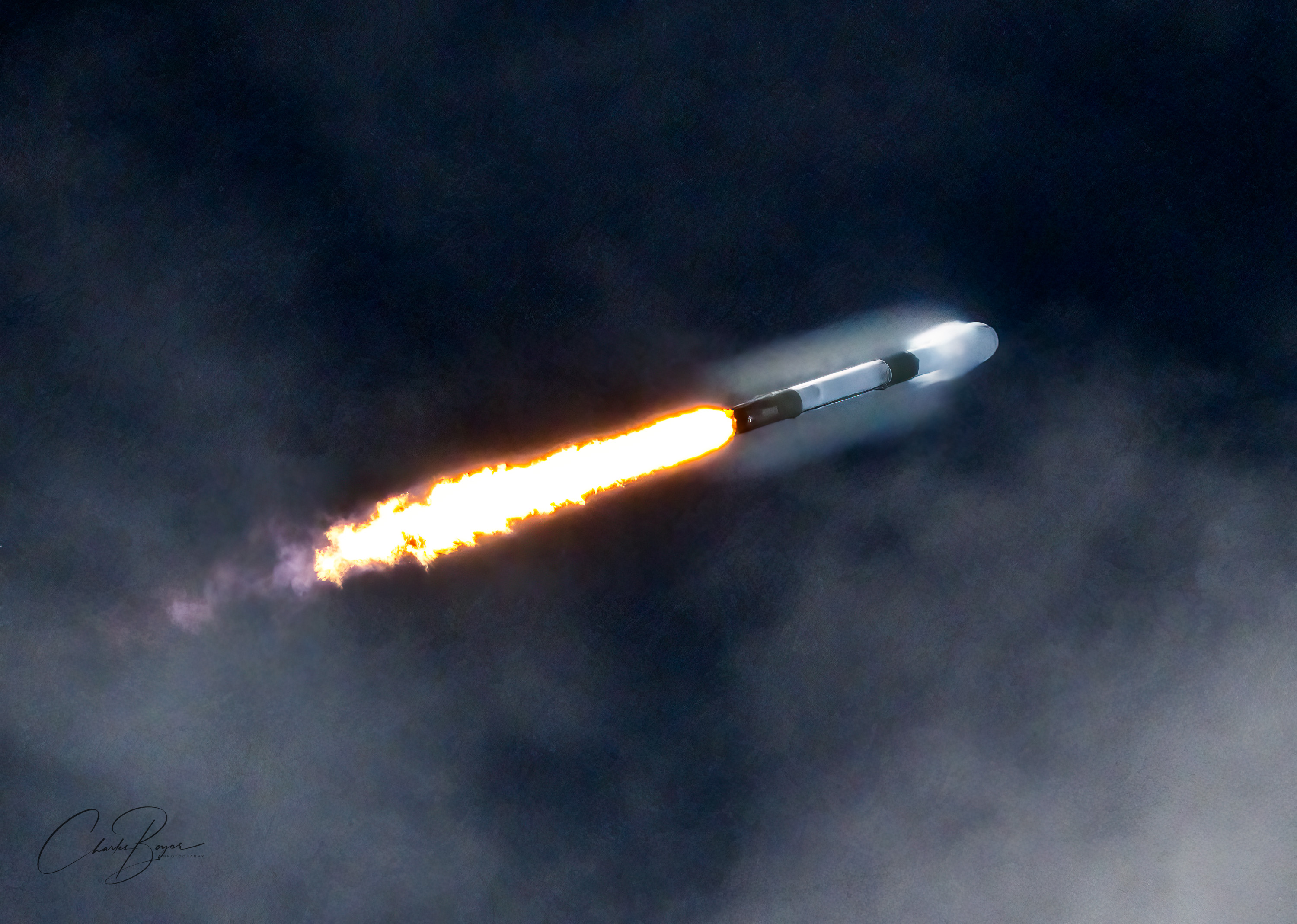
United Launch Alliance successfully launched its Vulcan Centaur rocket early Thursday morning, carrying a national security payload for the U.S. Space Force on the USSF-87 mission.


Liftoff occurred at 4:22 AM ET from Space Launch Complex 41 at Cape Canaveral Space Force Station, about midway through a two-hour window that opened at 3:30 AM.

ULA ended its live launch coverage shortly after fairing separation at the request of the U.S. Space Force, as is standard for classified national security missions. The Centaur V upper stage will continue its work for nearly 10 hours — the longest mission ever flown by a Vulcan — to deliver all three payloads to their target orbit.
Another Solid Rocket Booster Issue?
During ascent one of the GEM 63XL solid rocket motors experienced an “observation” similar to the Vulcan CERT-2 issue: at T+1:08 into ascent, a shower of debris was seen behind Vulcan as it ascended. As with CERT-2, the rocket continued flying up to and after SRB separation. In all, there were three bursts of debris in the thrust plume of the rocket.
ULA stated that although there was an issue, the rocket continued to ascend and maintained its trajectory.

“Early during flight, the team observed a significant performance anomaly on one of the four solid rocket motors. Despite the observation, the Vulcan booster and Centaur performed nominally and delivered the spacecraft directly to geosynchronous orbit,’ said Gary Wentz, ULA vice president of Atlas and Vulcan Programs.
“The integrated U.S. government and contractor team is reviewing the technical data, available imagery, and establishing a recovery team to collect any debris. We will conduct a thorough investigation, identify root cause, and implement any corrective action necessary before the next Vulcan mission.”
The nature of the incident(s) will be analyzed by ULA, the GEM 63XL contractor, Northrop Grumman, and relevant US government authorities. How long this may delay the next flight of Vulcan is uncertain. What is certain is that this is not the news anyone at United Launch Allliance wanted to hear early this morning.
Payload
The mission is delivering two Geosynchronous Space Situational Awareness Program (GSSAP) satellites — GSSAP-7 and GSSAP-8 — along with a propulsive EELV Secondary Payload Adapter (ESPA) ring directly to geosynchronous orbit more than 22,000 miles above Earth.
Talk of Titusville will always be free to access.
If you love what we’re doing, please consider becoming a monthly Supporter HERE.
Built by Northrop Grumman, the GSSAP satellites serve as a “neighborhood watch” in the geosynchronous belt, tracking and characterizing objects in the increasingly crowded orbital environment. The ESPA ring will be used by Space Force Guardians to refine tactics and procedures for precision on-orbit maneuvers.

USSF-87 marks the fourth flight of the Vulcan Centaur and just its second National Security Space Launch (NSSL) mission. The rocket flew in its VC4S configuration, powered by two Blue Origin BE-4 methane engines on the core stage and four Northrop Grumman GEM-63XL solid rocket boosters.
The launch also comes amid a leadership transition at ULA, with longtime CEO Tory Bruno recently departing to join Blue Origin. John Elbon is serving as interim CEO as the company works to increase its launch cadence and address a backlog of more than two dozen NSSL missions awarded under the Phase 2 contract.
Updates From Others
Next Launch
Next Launch: Falcon 9 Block 5 | Crew-12
Go for Launch • Cape Canaveral SFS, FL • SLC-40
| Field | Details |
|---|---|
| Mission | Crew-12 — the twelfth crewed operational flight of a Crew Dragon spacecraft to the International Space Station as part of NASA’s Commercial Crew Program. |
| Organization | SpaceX |
| Rocket | Falcon 9 |
| Launch Site | Cape Canaveral Space Force Station, Florida, USA |
| Pad | Space Launch Complex 40 (SLC-40) |
| Window Opens | Friday, 02/13/2026 5:15:00 AM (ET) |
| Window Closes | Friday, 02/13/2026 5:15:00 AM (ET) |
| Destination | Low Earth Orbit |
| Status Info | Current T-0 confirmed by official or reliable sources. |
| Mission Description | SpaceX Crew-12 is the twelfth crewed operational flight of a Crew Dragon spacecraft to the International Space Station as part of NASA’s Commercial Crew Program. |
| Countdown (to window open) | — |

Author: Charles Boyer
NASA kid from Cocoa Beach, FL, born of Project Apollo parents and family. I’m a writer and photographer sharing the story of spaceflight from the Eastern Range here in Florida.


Leave a Reply