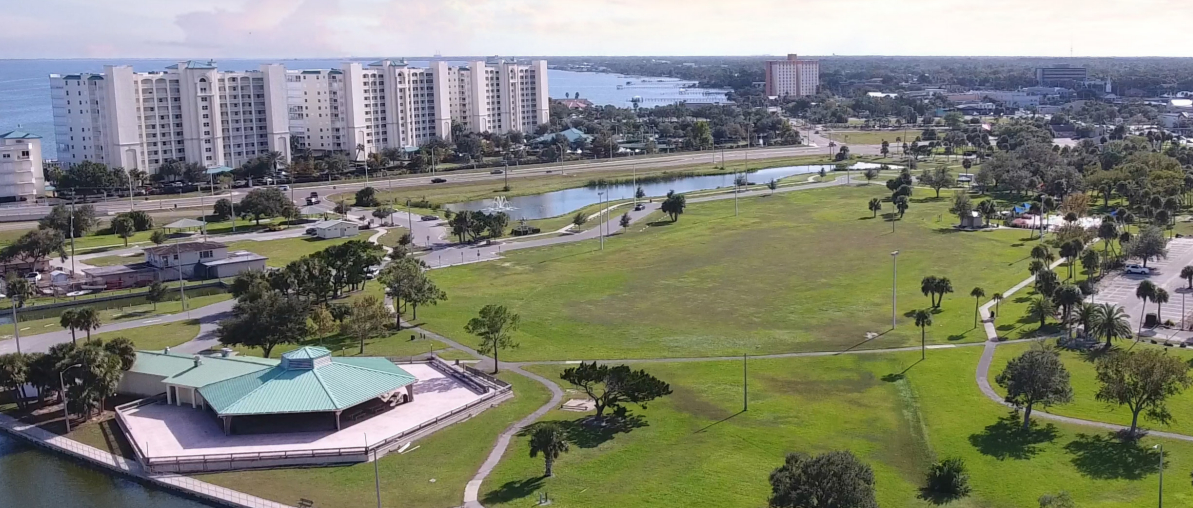


Photo: Charles Boyer / Talk of Titusville
It looks like hard times for the Space Coast’s local economy might be ahead.
The Administration’s proposed fiscal year 2026 budget includes a 24.3% reduction in NASA’s funding, decreasing the agency’s budget from $24.8 billion to $18.8 billion. This so-called “skinny” budget blueprint is a high level one short of full details, which will be forthcoming. After that, Congress will take up and begin debate on a budget bill.
This proposed significant cut threatens to eliminate key programs and could result in substantial job losses at Florida’s Kennedy Space Center (KSC), a cornerstone of the Space Coast’s economy, and that will have ripple effects that everyone who lives here will feel.
Key Programs on the Chopping Block
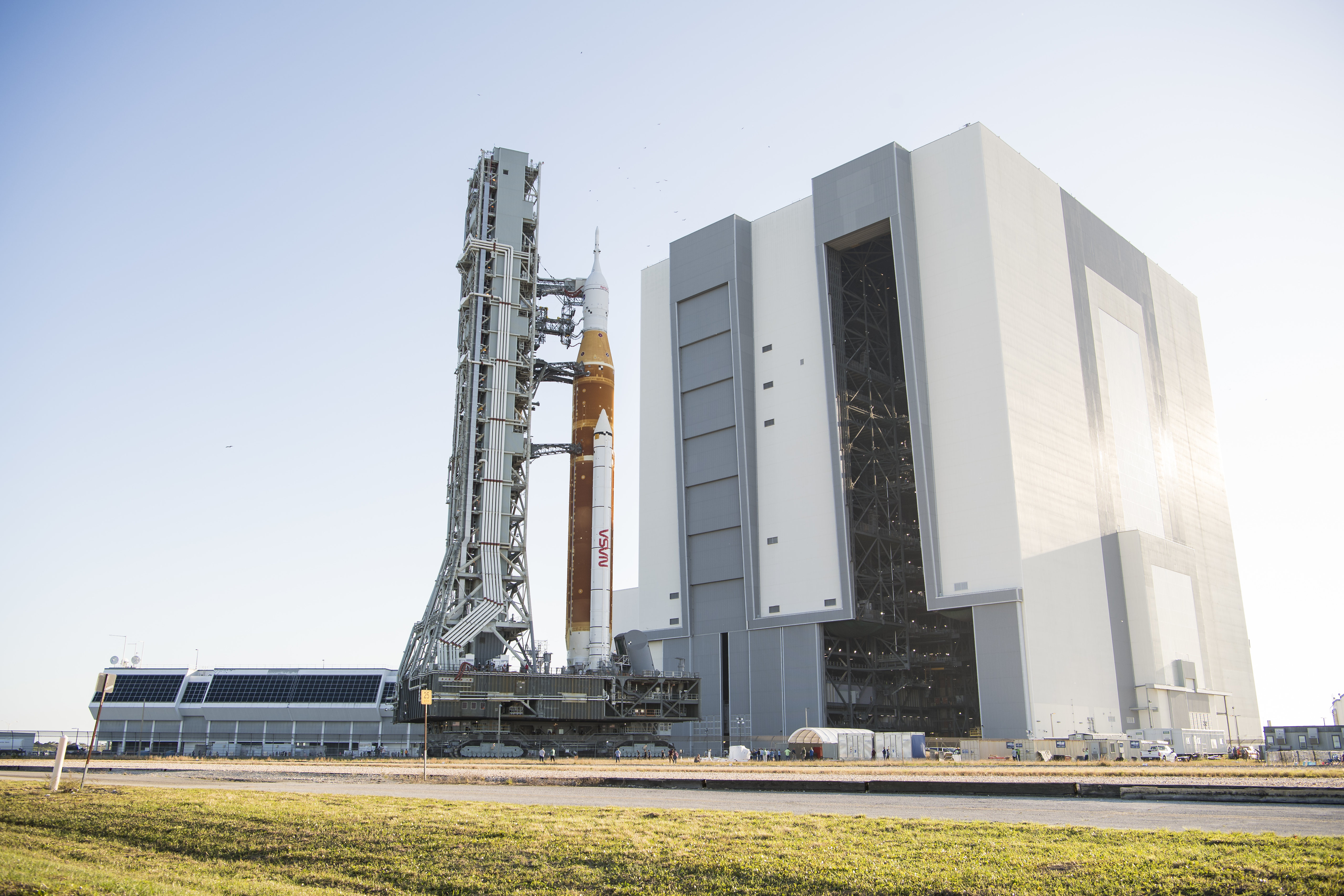
The proposed budget aims to terminate NASA’s Space Launch System (SLS) and the Orion crew capsule after the Artemis III in 2027. SLS is currently integral to the Artemis initiative, which seeks to return humans to the Moon. The administration justifies these cuts by citing cost overruns and delays, noting that the SLS has cost approximately $23 billion since 2010 and about $4 billion per launch. In its place, commercial launch services will be employed, assuming they are ready to do so in two years time.

The policymakers and budget writers have a point: SLS is an incredibly expensive rocket years late and billions over budget before getting to the launch pad. If the program were to continue, SLS would continue to be very expensive, and for capabilities that commercial providers will match or exceed in the near term.

In addition to the SLS and Orion, the budget proposes eliminating the Gateway lunar station and the Mars Sample Return mission. These cuts would not only affect NASA’s long-term exploration goals but also disrupt international collaborations with agencies from Europe, Canada, and Japan.
Again, policymakers have a point: these are expensive programs that are optional, and their elimination will result in cost savings to the federal budget.
Conventional wisdom in space circles is that SpaceX’s Starship program will replace SLS, and will rely on Kennedy as one of SpaceX’s primary launch sites for the giant rocket still under development in Texas. SpaceX has already resumed construction on a Starship launch mount at LC-39A, and has also begun building facilities here to support the giant rocket. With those expansions will come new jobs as well as opportunities for local businesses to provide support. Around 600 new SpaceX jobs are projected for the Starship effort.
Blue Origin, with its lunar lander and nascent New Glenn rocket, will also presumably benefit, leading to more growth on their massive campus across from the Kennedy Space Center Visitors Center. The currently have around 237 openings posted for Merritt Island, that out of 484 positions listed nationally.
SpaceX and Blue Origin aren’t the only two large aerospace companies with major facilities in the region, of course, and as military and commercial space continues to grow, employment opportunities grows with it. The Space Coast also has a healthy startup culture, and many of those companies are on the cusp of expansion in their own right.
That will offset some of the job losses locally in the short term.
Impact on Kennedy Space Center and the Space Coast
In fiscal year 2023, NASA activities in Florida supported 35,685 jobs and contributed $8.2 billion in economic output. The proposed budget cuts threaten to drastically lower this economic contribution.
Kennedy Space Center is a major economic driver on the Space Coast, Terminating the SLS would directly impact thousands of workers involved in the project. NASA will undoubtedly trim jobs, as will Jacobs and Bechtel, who employ hundreds at the center. Moreover, the ripple effects could extend to local businesses and suppliers that rely on NASA contracts.
The Space Coast has been through this before: in the 1970s after the Apollo program was ended and after the Space Shuttle program flew its last flight in 2011. Home prices tumbled due to local oversupply, local businesses and restaurants shuttered thanks to a drop in the number of customers coming through their door.
Concerns For Local Leaders and Experts
A local resident who works for NASA at the Cape, but didn’t want to share their name said yesterday that, “This will be like it was in the 70s after Apollo and fifteen years ago after the Shuttle. Home values dropped, and some people just left and let the bank foreclose their homes. It was ugly.”
Indeed, the conclusion of NASA’s Space Shuttle program in 2011 marked a significant turning point for Brevard County’s economy. The retirement of the shuttle led to the loss of approximately 7,000 jobs at Kennedy Space Center alone, with estimates of up to 9,000 when including contractors and support staff.
This sudden unemployment surge pushed the county’s jobless rate to over 11%, far surpassing the state average at that time. Local businesses, from restaurants to retail stores, felt the ripple effects as disposable incomes dwindled. The housing market also suffered, with property values declining and foreclosures increasing. The economic downturn lingered for years until the rise of SpaceX, the arrival of Blue Origin and NASA’s Artemis Project.
Whether the cancelation of SLS affects the local economy as much as some fear remains to be seen. The Space Coast has diversified its economic base, but it is also still highly dependent on NASA and the military for its overall livelihood.
Titusville
Titusville, often called the “Gateway to Space,” bore the brunt of the Shuttle program’s end. The city’s economy, deeply intertwined with space exploration, faced significant challenges. Businesses shuttered and moved out, people moved away, and some say Titusville has never fully recovered.
Local schools saw decreased enrollment, home values plunged, and local tax revenues dropped precipitously, which, in turn, created issues that the city is dealing with to this day. Titusville has also grappled with an identity crisis, striving to redefine itself as being more than its space-centric legacy.
Efforts to attract new industries and promote tourism began after the Shuttle Era, but the transition has proven arduous and ongoing, especially given that tourism there is a harder sell than it is just twenty minutes down the road in Cocoa Beach. That’s because Titusville lost most of its beach access when the federal government seized Titusville Beach in the early 1960s to build the Kennedy Space Center in the first place. Payalinda Beach on the Cape Canaveral National Seashore is there, of course, but its location in a wildlife refuge has limited commercial growth.
On the industrial front, Titusville and the Space Coast region has a lot of what businesses look for: a business-friendly government, relatively low taxes, land available near multiple transportion options, and a skilled workforce that can fill jobs requiring technical skills.
The city is already seeing facility expansions and new factories being constructed; for example, Lockheed Martin is building a new facility that is expected to employ up to 300 people. Other major companies and facilities have come, some have gone belly up and others have stated plans to move here in the future.
Is America Really ‘Effectively Ceding Its Leadership In Space’?
Many industry experts have also expressed alarm over the proposed budget cuts, especially to NASA’s science budget. They argue that reducing NASA’s funding could have long-term detrimental effects on the nation’s space leadership and the economic well-being of communities like the Space Coast.
“The proposed cuts could plunge NASA into a dark age,” warns the Planetary Society, emphasizing the potential loss of scientific knowledge and international prestige.
“If enacted, these proposed cuts would demolish our space economy and workforce, threaten our national security and defense capabilities, and ultimately surrender the United States’ leadership in space, science, and technological innovation to our adversaries,” wrote the bipartisan co-chairs of the Congressional Planetary Science Caucus.
“We will work closely with our colleagues in Congress on a bipartisan basis to push back against these proposed cuts and program terminations and to ensure full and robust funding for NASA Science in Fiscal Year 2026 appropriations,” the statement concluded.
That statement may well be representative of the response the NASA budget will receive on Capitol Hill. NASA receives widespread support, and while calls to streamline NASA will probably get a lot of support, eliminating projects like the Nancy Grace Roman space telescope will receive strong pushback.
Next Steps
The budget proposal is subject to approval by Congress, where it is expected to face significant scrutiny and potential revisions. Lawmakers from both parties have historically supported NASA’s missions and may push back hard against the proposed cuts to preserve the agency’s programs and the jobs they support. That remains to be seen.
As the budget process unfolds, stakeholders from the Space Coast and beyond will closely monitor developments and advocate for the preservation of programs they say are vital to the nation’s space exploration efforts and economic health. Others from here will point out the necessity for more austerity in the federal budget and that NASA, like all federal agencies, will have to shrink their budgets to accomplish that goal.
Where the chips all land is certainly going to be something to watch, but one thing is clear: things will be changing.

Author: Charles Boyer
NASA kid from Cocoa Beach, FL, born of Project Apollo parents and family. I’m a writer and photographer sharing the story of spaceflight from the Eastern Range here in Florida.




Leave a Reply