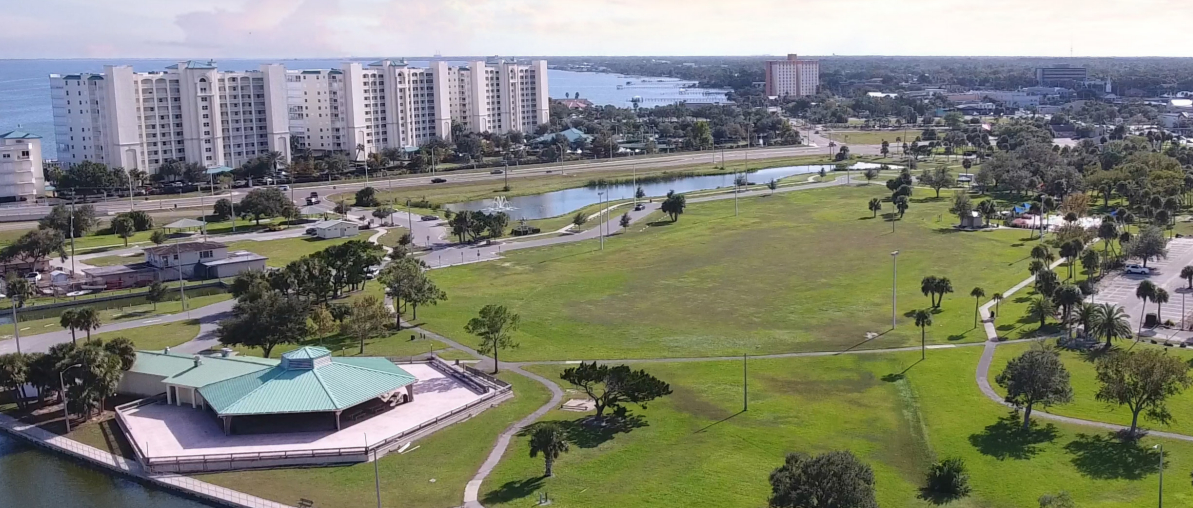
A groundbreaking ceremony was held Wednesday for the Titusville Causeway Multi-Trophic Restoration and Living Shoreline Resiliency Action Project, a unique initiative aimed at restoring the Indian River Lagoon.

The project, the first of its kind in Florida, will combine multiple restoration techniques to address shoreline erosion, improve storm resiliency, and enhance critical wildlife habitat within the lagoon.

A Titusville Causeway rendering from Sea & Shoreline shows the after restoration impacts the Multi-Habitat Resiliency project is expected to create.(Sea & Shoreline)

“This is a very multi-purpose project,” said Virginia Barker, Director of Brevard County’s Natural Resources Management Department. “We’re trying to accomplish a lot of things all at once.”

The $4.2 million project is being undertaken by aquatic restoration experts Sea & Shoreline. The initial phase will involve the fabrication and installation of 648 Wave Attenuation Devices (WADs) along the shoreline. 

A Titusville Causeway rendering from Sea & Shoreline shows the after restoration impacts the Multi-Habitat Resiliency project is expected to create.(Sea & Shoreline)

These structures will absorb wave energy generated by storms, helping to protect the causeway and promote sediment accumulation.

“That energy will come through, but any sediment that’s in the water column, it’s pretty heavy. It’s going to fall out behind it,” explained Andrew Risi, Vice President of Sea & Shoreline.

A rendering from Sea & Shoreline shows the after impacts the Multi-Habitat Resiliency project is expected to create. (Sea & Shoreline)

Following WAD installation, the project will involve the restoration of the shoreline with 4,150 cubic yards of material. Additionally, four acres of seagrass will be planted, and one million clams will be seeded within the lagoon.

“That seagrass is the underwater rainforest that provides the underwater habitat for the fish and critters that love the diversity and abundance of this lagoon,” said Barker.

The project is anticipated to be completed by spring 2025.

titusvillemedia
Author: titusvillemedia

Raised on the Space Coast, I want to keep North Brevard informed of what's happening. Send Tips / Story Ideas to TitusvilleMedia@gmail.com


14 responses to “First-of-Its-Kind Lagoon Restoration Project in Titusville”

  1. JEFFREY ALAN SWANSON Avatar
    JEFFREY ALAN SWANSON

    As a clammers father, I understand clams live in tidal flow estuaries. No diurnal tidal flow, no clams.

    1. There were millions of clams here back in early 2000, unfortunately, clammers came in with there rakes and wiped them out! 2005..
      They killed a lot of the seagrass as well. I hope they are never allowed to come back!

  2. I would like to see a pipe that would also flush in-out water to the ocean.
    Land is all Federal Government so it would not be an issue.
    Last Hurricane washed over at Eddie’s Creek and helped the north side of the lagoon a 1000 percent grass came back in less then a year.
    Fishing is now the best in 20 years.

    1. JEFFREY ALAN SWANSON Avatar
      JEFFREY ALAN SWANSON

      I have often thought the same. A real good project for University to model and assist in supporting funding. A WIN-WIN for the estuary, the adjacent beaches and citizens. Paging Teddy Roosevelt.

    2. Sebastian has an inlet, and the grass bounce back there has been slower than Mosuito Lagoon. Fresh sea water isn’t a magic bullet. Inlets are very expensive to open and maintain. It’s not happening.

    3. The hurricane washing over the dunes at Eddy Creek was a single event that was unrelated to any improvements to the north end of the IR Lagoon. We’ve had no overtopping in last 18 months, yet the improvements in seagrass at Titusville I’ve seen are in the last 12 months.

    4. Absolutely need to have fresh sea water. Don’t know why they don’t do it. Would clean up the lagoon quickly!!!!

  3. Wouldn’t it be more cost effective just to open a new inlet at turtle mound where it meet’s Playlinda beach?

  4. Clamming and oyster harvesting need to be banned with violators receiving hefty fines and mandatory jail time for any repeat offenders. No exceptions.

  5. It sounds like all access 2 shore use is being limited. In MY inter coastal waterways. I came at 4yrs old. The river has been my life. I’m only 65yrs old now. The fault rest on the shoulders of the takers. I personally killed 100 trout and reds in 1 night. For sport.
    The decimation of the logo on. Rest on the ones who polluted the waterway. The city of titusville. Sewage ran unchecked into MY river for decades. Climbers and crabbers had nothing 2 do with its demise. I grow weary with this conversation. Tha a step back and realize that this is a loosing battle. Until the city keeps flushing our toilets into MY River.

    Keep building and MY love is Doomed.

    Swamp Out.

  6. It doesn’t really do much good to plant sea grass when the Manatees are allowed to become over populated. What do they eat? Sea Grass.
    Also, the dolphin have become over populated as well. What do they eat, fish like redfish, snook, and sea trout. They have decimated those fish within the enclosed southern Mosquito Lagoon & Northern Indian River.
    More attention needs to be given to the over population of Manatees and Dolphins. That will do more to revitalized the Lagoon than your bandaid approach that is just going to make you feel like your doing something good, when your not addressing the root cause.

  7. Kurt D Emmick Avatar
    Kurt D Emmick

    Ask these marine environmentalist. Has anyone researched the impact to the lagoon from tuns of APCP Ammonium Perchlorate discharge over a thirty year period of Shuttle, then discharged into the lagoon by said hurricane, destroying the dunes/dikes at Eddy Creek. This brought on the start of our algae explosion. It’s time it flush the toilet. 42 mil project is like putting lipstick on a dirty pig.

  8. Restoration projects are good no matter how small when they gappen! A lot of things should be banned in Florida…boating, jetskiing, illegal fishing/hunting, guns, and idiots

  9. I’m glad we are trying to restore the lagoon but I also think it’s important to restore all the trees and plants such as mangroves specifically on the residential shores. The roots of these plants are what keep the sand from eroding in the first place and numerous amounts of plants have been removed in place of buildings and houses. The solution for people seems to be dumping rocks along the shore but that’s not only ugly to look at but temporary as they need constant replacing.

Leave a Reply

Trending

Discover more from TalkOfTitusville.com

Subscribe now to keep reading and get access to the full archive.

Continue reading