


After the Artemis II crew splashed down Friday, NASA and Kennedy Space Center are already looking ahead. Hardware for Artemis III — the mission NASA has redesigned as a critical crewed rendezvous-and-docking demonstration in low Earth orbit — is converging here on the Space Coast from facilities across the country, and the pace is picking up fast.

New Mission Plan
NASA has restructured Artemis III significantly since its original conception as humanity’s first crewed lunar landing since Apollo.
Following an announcement by NASA Administrator Jared Isaacman in late February 2026, the mission is now planned for mid-2027 as a crewed test flight in Earth orbit, where astronauts aboard Orion will rendezvous and dock with one or both commercial lunar landers ahead of the first actual lunar landing attempt on Artemis IV, which is currently targeted for early 2028. Think of it as NASA’s Apollo 9: a full-dress rehearsal before anyone goes to the surface.
The Long Pole: Landers

The two commercial landers at the center of NASA’s Artemis architecture are progressing on very different timelines, and neither is fully ready for the crewed missions ahead. SpaceX’s Starship Human Landing System remains the most technically complex piece of the puzzle. The vehicle is still in testing, with its next flight coming in a few weeks. It needs to be sufficiently completed and launched into orbit so that Artemis III can attempt test docking.
SpaceX demonstrated a small internal cryogenic transfer during its third integrated Starship test flight, but the critical ship-to-ship transfer demonstration — originally planned for mid-2025 — had still not occurred as of March 2026 and is now expected sometime in 2026. That milestone is a prerequisite for human certification of the system. In the meantime, SpaceX has been fabricating a flight-article HLS cabin at Starbase in Texas, including functional life support, avionics, and crew systems hardware, and the company has confirmed the propellant transfer flight test remains a priority target for this year.

Blue Origin’s path is more near-term in some respects, with tangible hardware already taking shape close to home. The first Blue Moon Mark 1 uncrewed cargo lander, a roughly 8-meter-tall spacecraft powered by the company’s BE-7 liquid hydrogen engine, has been undergoing preprations at a dedicated production facility at Port Canaveral, just south of Cape Canaveral Space Force Station. It is expected to launch this year on a lunar test mission.
Artemis Human Landing Systems — SpaceX vs Blue Origin
| Topic | SpaceX Starship HLS | Blue Origin Blue Moon Mark 2 |
|---|---|---|
| Mission assignment | ||
| Artemis mission | Originally contracted for the Artemis III lunar landing. Following NASA’s February 2026 restructure, the first crewed lunar landing is now Artemis IV, targeted for early 2028. | Artemis V. Blue Moon Mark 2 is contracted for sustained lunar development missions beginning with Artemis V. |
| Refueling architecture | ||
| Requires orbital refueling? | Yes. NASA says Starship HLS is fueled in low Earth orbit before going to lunar orbit. | Yes. NASA’s OIG says Blue Moon Mark 2 uses multiple in-space refueling steps via the Cislunar Transporter. |
| Publicly described refueling setup | NASA describes a Starship fuel depot plus ~10+ Starship tanker flights, with HLS fueled in LEO and then sent to NRHO to pre-stage and await crew. | NASA OIG describes a Cislunar Transporter (built by Lockheed Martin, launched on New Glenn) that assembles and fuels in LEO, then travels to NRHO where it docks with and fuels Blue Moon — with multi-altitude propellant aggregation and a final top-off in NRHO. |
| Staging orbit before crew arrival | NRHO. NASA says the fueled lander is pre-staged there and can loiter up to 100 days awaiting Orion. | NRHO. Blue Moon receives its final propellant transfer from the Cislunar Transporter there before crew arrival. |
| Complexity and readiness | ||
| Architecture complexity | Simpler in NASA’s public Artemis summary: depot fills in LEO, HLS fuels and pre-stages in NRHO. Still requires ~10+ tanker launches at rapid cadence. | More elaborate: requires developing three distinct vehicles — the lander, a tanker, and the Cislunar Transporter. Multi-step propellant aggregation across orbital altitudes before final NRHO delivery. Designed for full reusability. |
| Key milestone still to prove | Large-scale ship-to-ship cryogenic propellant transfer in orbit. Originally targeted for mid-2025, now expected in 2026. Not yet demonstrated as of April 2026. | Cryogenic propellant transfer via the Cislunar Transporter. Blue Moon Mark 1 Pathfinder (2026) will demonstrate BE-7 engine and cryogenic fluid systems; the full Cislunar Transporter refueling architecture has not yet been demonstrated in flight. |
Note: Sources: NASA OIG report IG-26-004 (March 2026); NASA HLS program; Wikipedia (Starship HLS, Blue Moon); SpaceNews. Status as of April 2026.
Blue Origin’s senior director of civil space, Jacqueline Cortese, confirmed that the Mark 1 lander is undergoing final stacking in Florida and that the company is already ramping up production, with the aft section of the second vehicle in structural testing. The Mark 1 Pathfinder mission, a demonstration flight to the lunar south pole, is planned to launch on a New Glenn rocket and would validate the BE-7 engine, precision landing systems, and cryogenic fluid management critical to future crewed missions.
Blue Origin’s crewed lander, the larger Mark 2, is contracted for Artemis V and would require orbital refueling via a Lockheed Martin-built Cislunar Transporter.
Clearly, there is a lot of work to be done: Starship is not operational as of yet, and Blue Origin has not flown its Mark 1 lander, which will, in turn, inform its planned crew lander. For a lunar landing any time in 2028, both companies will need to move very quickly.
The Core Stage Is Coming Soon
The most significant near-term arrival for Kennedy Space Center will be the bulk of the Artemis III SLS core stage — what NASA calls the “top four-fifths” of the rocket. That structure encompasses the liquid hydrogen tank, the liquid oxygen tank, the intertank, and the forward skirt. It’s all being assembled by Boeing at NASA’s Michoud Assembly Facility in New Orleans. Teams completed the major forward-and-aft join on January 8, 2026, locking four of the five major core stage components together. Systems integration and checks followed, and the stage is now being prepared for the trip here.

NASA announced this week it is hosting a NASA Social event at Michoud in mid-to-late April for the rollout of the Artemis III core stage ahead of its barge departure to Kennedy. The hardware will make the journey aboard the Pegasus barge, following the Intracoastal Waterway and coastal Gulf route before arriving at Kennedy’s barge Turn Basin — the same route taken by every SLS core stage before it.
Engines Are Ready
Meanwhile, the engine section of the Artemis III core stage has already been at Kennedy since last summer. It moved into Vehicle Assembly Building High Bay 2 in late July 2025 and has been undergoing integration and checkout there while waiting for the rest of the stage to arrive. The full core stage integration is expected once the Michoud hardware reaches Florida.

The four RS-25 engines assigned to Artemis III were processed at NASA’s Stennis Space Center in Bay St. Louis, Mississippi, and are confirmed complete and in storage, ready to be called up for integration into the engine section at Kennedy. All four are former Space Shuttle engines, refurbished and recertified for SLS service.
SRBs Are Rolling Towards The Cape
In what may be the most immediately exciting development for the Artemis III flow, the solid rocket booster segments are no longer sitting in Utah. Artemis III aft skirt SRB segments have arrived at the Kennedy Space Center in Florida for processing. Additionally, SRB components have recently been transported via rail through Alabama for further integration.

SLS program deputy manager Chris Cianciola confirmed this week that the booster segments that are manufactured by Northrop Grumman at their Promontory, Utah facility, were being loaded onto rail cars and were ready for shipment, with arrival at Kennedy expected this month.
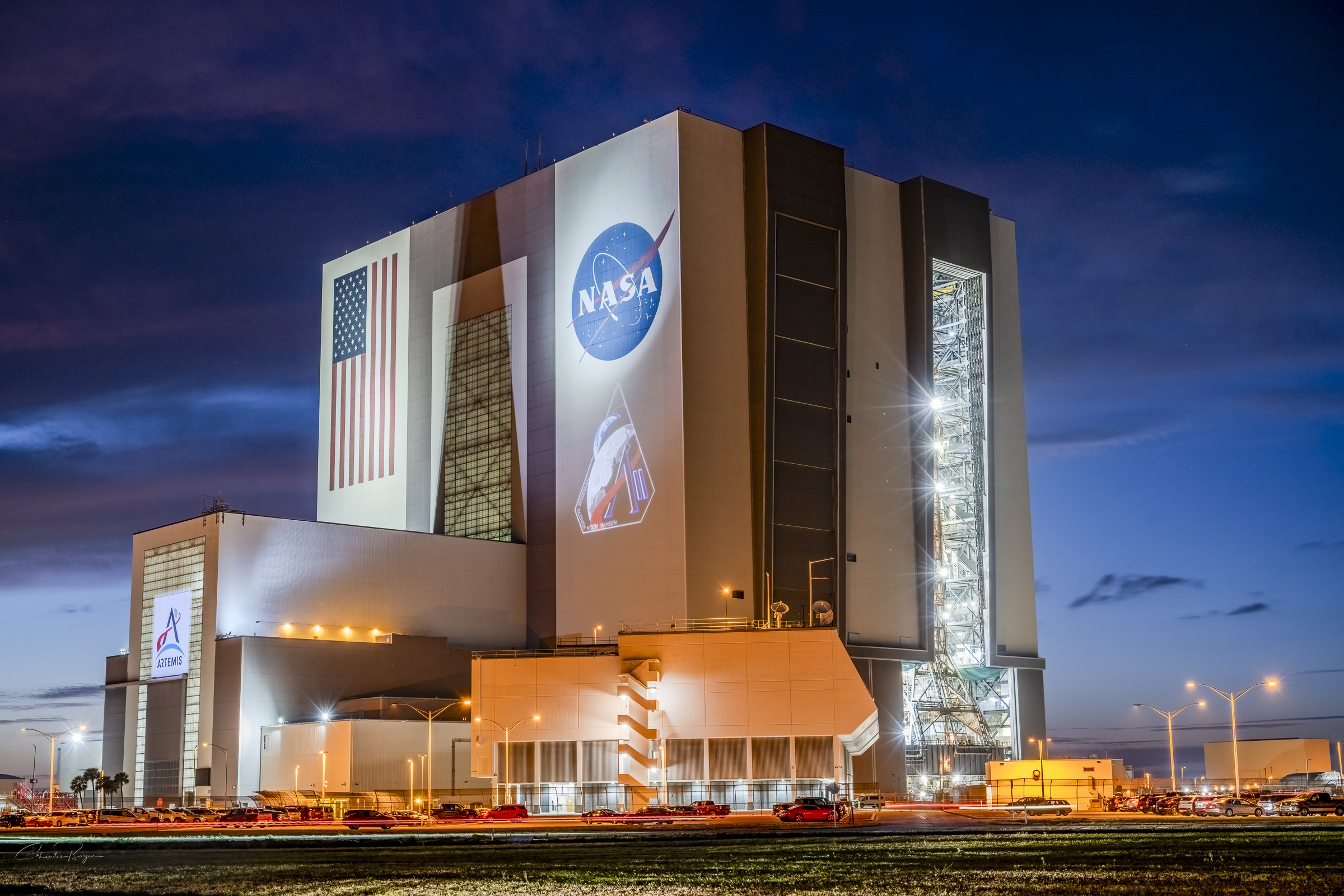
Those segments will be among the first Artemis III hardware to be stacked in the VAB once the mobile launcher is cleared and assessed following the Artemis II launch.
Orion Is Already Here

The Artemis III Orion crew module and its European Service Module are already at Kennedy, inside the Neil A. Armstrong Operations and Checkout Building. NASA has confirmed the crew module was powered on for the first time at Kennedy and has been going through functional, pressure, and leak testing. The ESM — ESM-3, built by Airbus in Bremen, Germany for the European Space Agency — shipped to the United States in August 2024 and was joined with the crew module adapter at Kennedy in September 2024. Both are continuing to advance through testing in the O&C Building while the rocket hardware catches up.

Launch Platform Work Already Underway
With Artemis II splashdown targeted for April 10 in the Pacific Ocean, Kennedy’s recovery and assessment teams will turn immediately to evaluating Mobile Launcher 1 and Launch Pad 39B for any damage from last week’s launch. The SLS is the most powerful rocket ever to reach orbit, and the Artemis I launch in 2022 caused significant damage to the mobile launcher, requiring months of repairs. How ML-1 fares from Artemis II will help set the pace for how quickly the VAB can begin Artemis III stacking operations.
NASA has also confirmed it is harvesting usable hardware from Mobile Launcher 2 — the now-halted second tower under construction near the VAB — to support ML-1 as a source of critical spare components, some of which have long procurement lead times.

Photo: Charles Boyer

Author: Charles Boyer
NASA kid from Cocoa Beach, FL, born of Project Apollo parents and family. I’m a writer and photographer sharing the story of spaceflight from the Eastern Range here in Florida.



Leave a Reply