


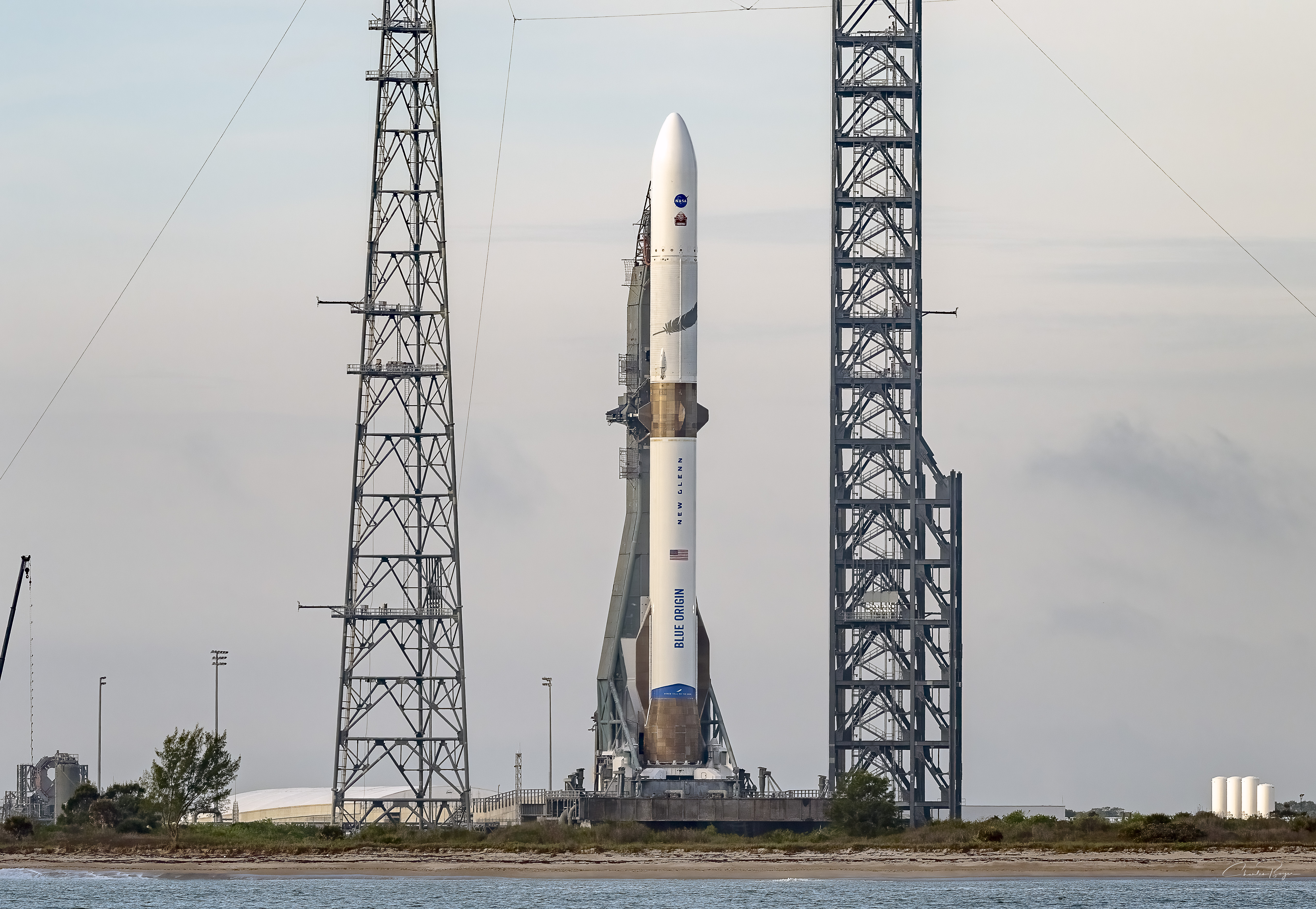
Blue Origin has delayed the launch of its second New Glenn rocket to no earlier than Sept. 29. After flying a successful mission in January, Blue had stated that the target date for NG-2 was first in “late spring,” and later adjusted to NET August 15.

The prime mission for the launch is NASA’s ESCAPADE mission. New Glenn will carry two small satellites tasked with studying the Martian magnetosphere, and will be New Glenn’s first interplanetary mission and the first multi-spacecraft orbital science mission aimed at Mars. NG-2 will also carry a technology demonstration payload for ViaSat, in support of NASA’s Space Operations Mission Directorate’s Communications Services Project.
A tertiary goal for this mission will be a successful landing of the New Glenn first stage on the company’s landing platform, which will be stationed downrange offshore in the Atlantic. Blue plans to fly as many as 25 missions with each booster, targeting significant cost reduction and operational efficiency for each flight, and is considered to be a necessity for the long-term financial viability of the company.

Finally, a successful second flight will serve as another technology demonstration for future customers, namely the Department of Defense, NASA and Amazon. Blue was awarded National Security Space Launch (NSSL) Phase 3 Lane 2 heavy-lift provider status, and is a $2.4 billion contract for the company. Amazon has also contracted New Glenn for at least 12 launches of its Project Kuiper satellites, and Blue Origin itself is building out its first lunar lander, Blue Moon Mk1, part of its lunar lander services contract with NASA and the Artemis Program. That spacecraft will need a ride on New Glenn as well.
Whether Blue launches in September remains to be seen. Delays in new launch systems are hardly uncommon, and on its second flight, Blue Origin has a full plate payload and operations-wise. To successfully achieve each objective, the company will be sure to double, triple, quadruple check every component and procedure leading up to the launch, and then they’ll probably check again after that just to be sure. That takes time, and if any issues are found, it will take time to resolve them. The old axiom of “fly only when you’re ready” still applies.

So, as always, stay tuned. There’s more to come.


Author: Charles Boyer
NASA kid from Cocoa Beach, FL, born of Project Apollo parents and family. I’m a writer and photographer sharing the story of spaceflight from the Eastern Range here in Florida.

Leave a Reply